The World Might Be William Shakespeare’s Stage, But the Story Belongs to Agnes
In the movie version of “Hamnet,” Shakespeare’s wife Agnes, played with wild abandon by the actress Jessie Buckley, looms large with possibility.

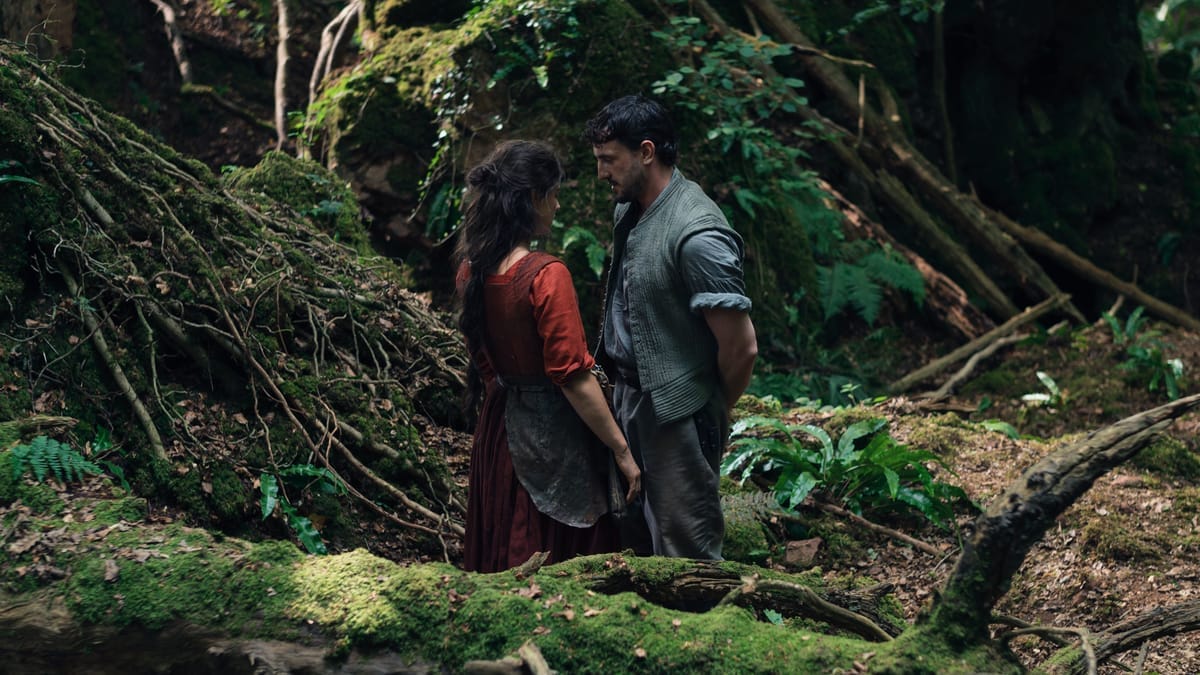
You could say the character of Agnes Shakespeare, brilliantly portrayed by Jessie Buckley in the film adaptation of Maggie O’Farrell’s 2020 bestselling novel “Hamnet,” is a woman who makes the ultimate sacrifice. (Is it a coincidence that O’Farrell gave this fictionalized version of William’s wife the name Agnes, Latin for lamb, as in the lamb of God, the über sacrificial lamb? It is not.)
Agnes is a gifted healer who knows how to mix a mean homeopathic elixir. Agnes also has a penchant for predicting the future. Those traits, and her intense connection with the natural world, give her an almost mystical, magical quality: She is a woman who, as she wanders with a bird of prey perched on her gloved hand, could seemingly accomplish anything her heart desires. All of which makes the fall to earth that much harder when she finds herself at home raising three kids, more or less on her own. Sounds like a familiar story…
When I watched the movie, directed by Chloe Zhao (who won an Oscar for “Nomadland” and also nabbed a Best Director Golden Globe nomination for “Hamnet,” alongside Buckley’s nod for Best Actress), I had to wonder: If Agnes Shakespeare hadn’t had three kids to attend to and a house to keep up while her husband Will ran off to London to write plays, would she ultimately have drafted the first textbook on plant-based remedies, changing the course of medicine long before Elizabeth Garrett Anderson did so in 1865? Could she have been a precursor to Maria Sibylla Merian, the most famous woman naturalist of the 17th century and one of the earliest European naturalists to document her observations about insects?
Or, maybe if Will (played by Paul Mescal, who also got a Golden Globe nomination for Best Supporting Actor this week) had been around more after the death of their young son Hamnet, might Agnes have had the time and space to channel her desperate grief into a fictional account that, like Will’s “Hamlet,” would go on to become one of the most most widely-produced plays of all time?
Alas, poor Yorick, that’s not exactly how it went down.
A mysterious figure in history
Let’s be clear: Maggie O’Farrell’s “Hamnet” is fiction (as is the mystical, magical Agnes). Although historical records are incredibly sparse–a marriage certificate here, a will there–we do know that William Shakespeare’s actual wife was named Anne; that the two married in November of 1582 when she was 26 and he was 18; and that she was already pregnant with their first child, Susanna, when they wed, which was pretty standard at the time, birth control not yet being a thing.
The couple also had twins, a girl named Judith and a boy named Hamnet—a name interchangeable with Hamlet. Hamnet died of the bubonic plague at age 11. As for the rest of the vivid details in the book and the movie, there is virtually no factual evidence, though the real-life Anne’s epitaph, likely written by her surviving daughters Judith and Susanna, describes her as a beloved mother and “so great a gift.” In short, Anne was loved. But any other theories about whether she was a quirky botanist-feminist or may have had an outsized impact on her husband’s works, or even, perhaps, written sections of his plays herself, are not proven.
Still, a woman can dream, and O’Farrell and Zhao do dream, widely and deeply, of who the mysterious wife of Shakespeare might have been.
 Francesca Donner
Spotting Agnes
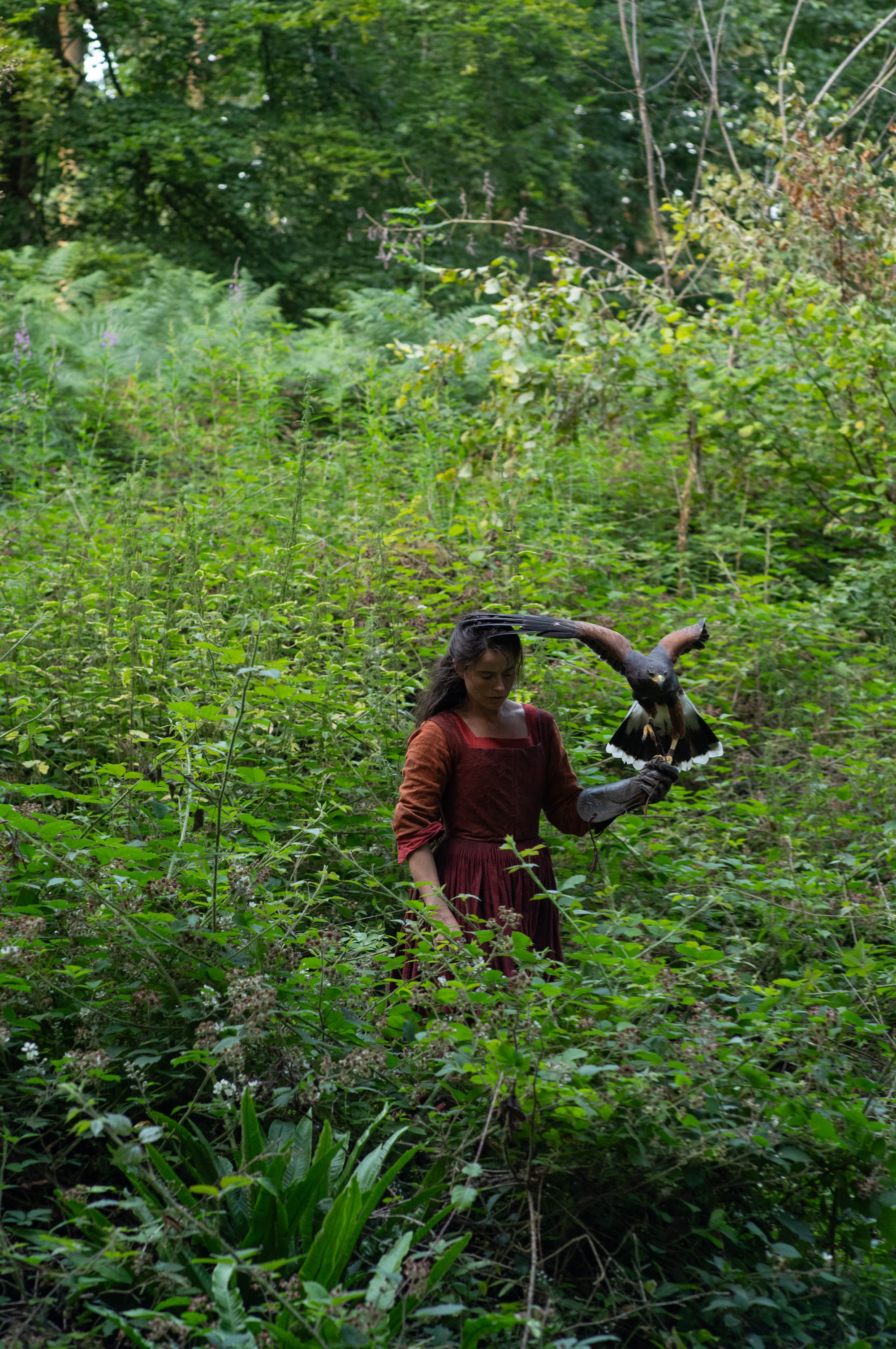
The first time we catch sight of Agnes, she is curled up at the base of a tree, as though she has emerged from its very roots. Later, we see her wandering the countryside near Stratford-upon-Avon with her falcon. Free of both makeup and pretense, she wears an unadorned blood-red frock that the film’s costume designer, Malgosia Turzanska, describes as “almost like a berry, poisonous if not handled with care.” It’s impossible not to admire this character’s fortitude—the scene in which she gives birth in the forest to her daughter, Susanna, entirely on her own, will forever have me praising the existence of the epidural.
William intuits, rightly, that Agnes is a force to be reckoned with when he first spies her out a schoolroom window. Inside, he is going through the motions of teaching young boys Latin to help repay a debt incurred by his father. As William soon discovers, he and Agnes are two falcons-of-a-feather — societal outcasts who immediately fall for one another. After a brief flirtation, it’s Agnes who makes the first move, lifting her skirt to welcome him in as the two consummate their relationship on a wooden table in a storage shed. Romantic? No. Hot? Yes.
When Agnes gets pregnant as a result of the encounter and they marry, her world instantly becomes smaller. That’s more than a metaphor: She goes from roaming outdoors to living in a claustrophobic cottage on the property of Will’s abusive father, John (David Wilmot), a glove-maker, and his mother, Mary (played by two-time Academy Award nominee Emily Watson (“Breaking the Waves”), a religious woman who wants nothing to do with her odd-duck daughter-in-law.
 Josie Cox
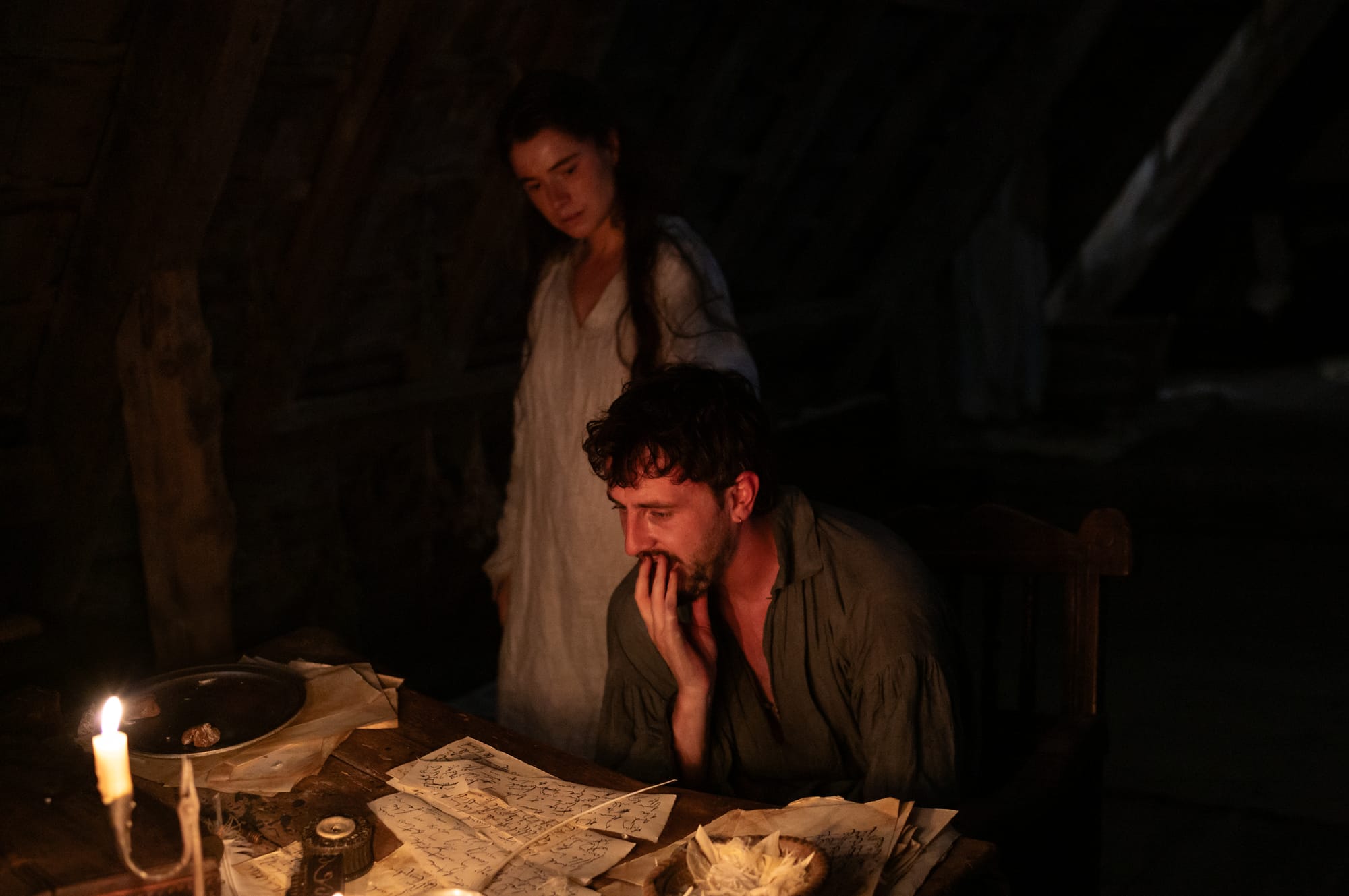
Complicating matters, Agnes understands that for William to fulfill his destiny—and for her and the family to avoid the dangers and diseases of the big city—she needs to make peace with letting him go to London to pursue his playwriting, leaving them behind.
All of this, of course, is a version of a tale as old as time. But it raises the question, over and over, of what if? What kind of world would we live in today if women had been permitted to be creative or even given the time to think about being creative? What might literature be like today? How would architecture be different? Who might we revere as the great “masters”?
The simmering resentment of the single mother
Naturally, William’s absence takes a considerable toll on the family and strains the couple’s marriage, but tensions come to a head as the plague ravages the countryside. And though William returns home periodically, he is mostly leaving, telling his son Hamnet to be brave, and to look after his two sisters and mother.
When Hamnet’s twin Judith falls ill with the plague, Agnes is, as is typical, the single parent at home, and she does everything in her power to save her daughter, frenetically mixing medicinal plants from the forest in an attempt to find a cure. This impresses her dour mother-in-law, who, having lost three children of her own, joins forces with Agnes and does what she can to help in William’s absence. Amazingly, Judith survives. But then Hamnet—deftly played by newcomer Noah Jupe—quickly succumbs, dying before his father can make it home.
Both Agnes and Will are wracked with guilt, she because she couldn’t save him; he because he wasn’t there. But while William is out the door again, Agnes is left behind to pick up the pieces. William at least has the reprieve of work to distract him from his grief, pouring his emotions into his writing.
Not surprisingly, Agnes comes to resent William. But it’s not until Agnes travels to London to see “Hamlet”— the play he has been working on since the death of their son—that Agnes realizes she has not been the only one suffering. William has created a piece of theatre so reflective of the human condition that it has since been translated into more than 75 languages. Good for him. It’s a chance she never had.
 Brianna Holt
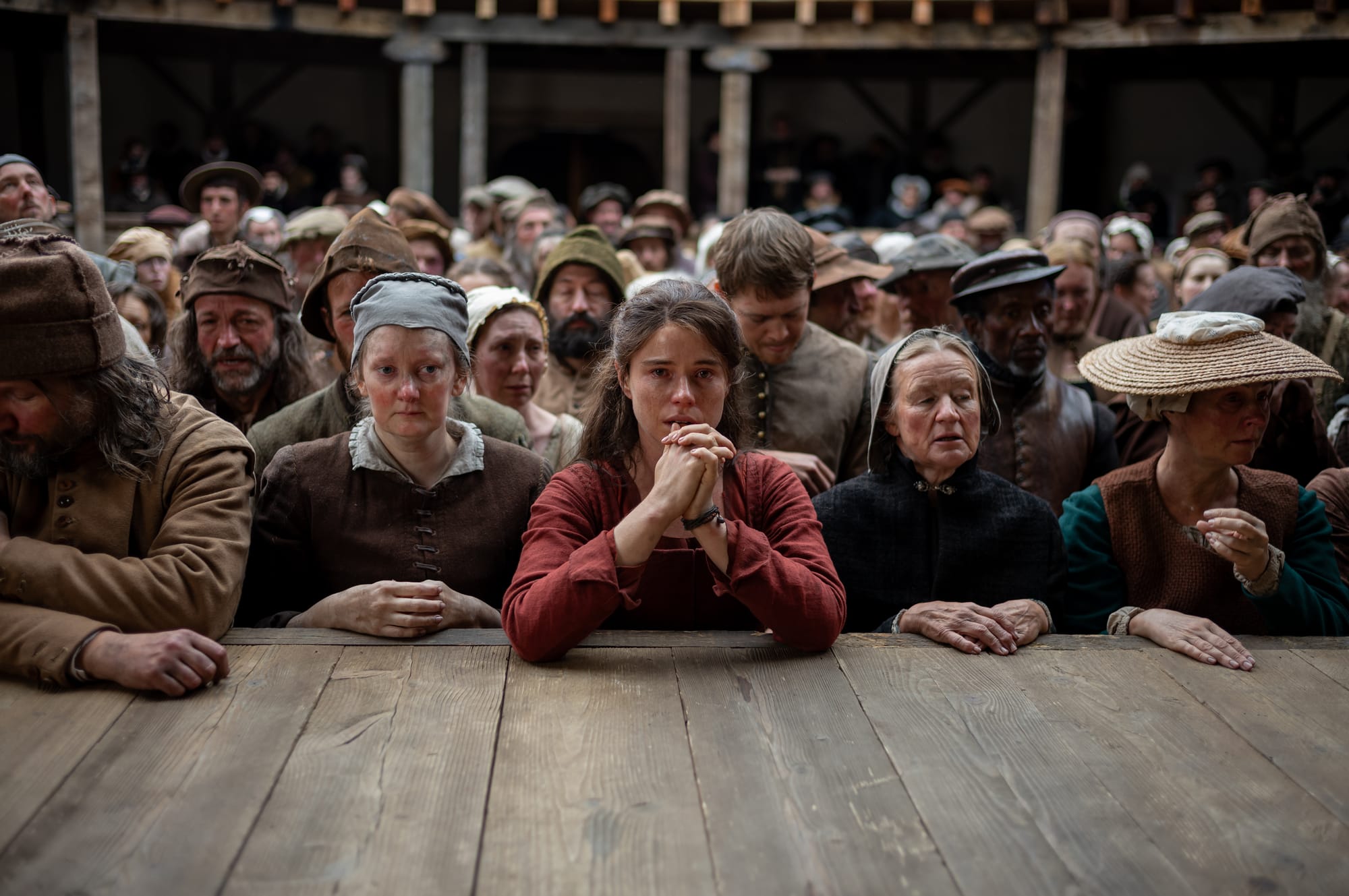
In the movie, there’s a memorable image of Buckley as she pushes her way closer to the stage and watches the drama at the Globe unfold along with hundreds of other mesmerized theatergoers. As her hardened features visibly soften, tears stream down her cheeks. In the actor who plays Hamlet, she sees an avatar of her son, she sees her grief, and her husband’s grief… all of it. It’s the catharsis she didn’t know she needed, and it helps to heal the chasm between her and her husband as she recognizes that his world was uprooted, too.
For Agnes, and for all of us, the relief is palpable. But the sadness lingers: A grief for her free spirit and gifts buried beneath a mountain of domestic duties. And in the background, like a drumbeat, the slow steady what if? What if William had been just a little more present in the relationship and in their home, freeing Agnes up to leave an indelible impression of her own on the world? What if, indeed.