How Online Shopping Spurred a Sex-Toy Boom In India
Indian women are taking charge of their own pleasure, guided by online influencers and easier access to a wealth of new products.

When Leeza Mangaldas returned home to India after a few years away studying in New York, she was struck by how little access young people had to even basic information about sexual pleasure.
While in college in the U.S., Mangaldas had taken part in workshops that dealt with sexual health and sexual pleasure, given out free condoms and talked openly about sex. When she returned home to Mumbai—India’s commercial capital and most liberal city—she found there was nothing like that available, at least in her networks. What little information young people were getting was coming from pornography, which was associated with shame. So Mangaldas decided to take action.
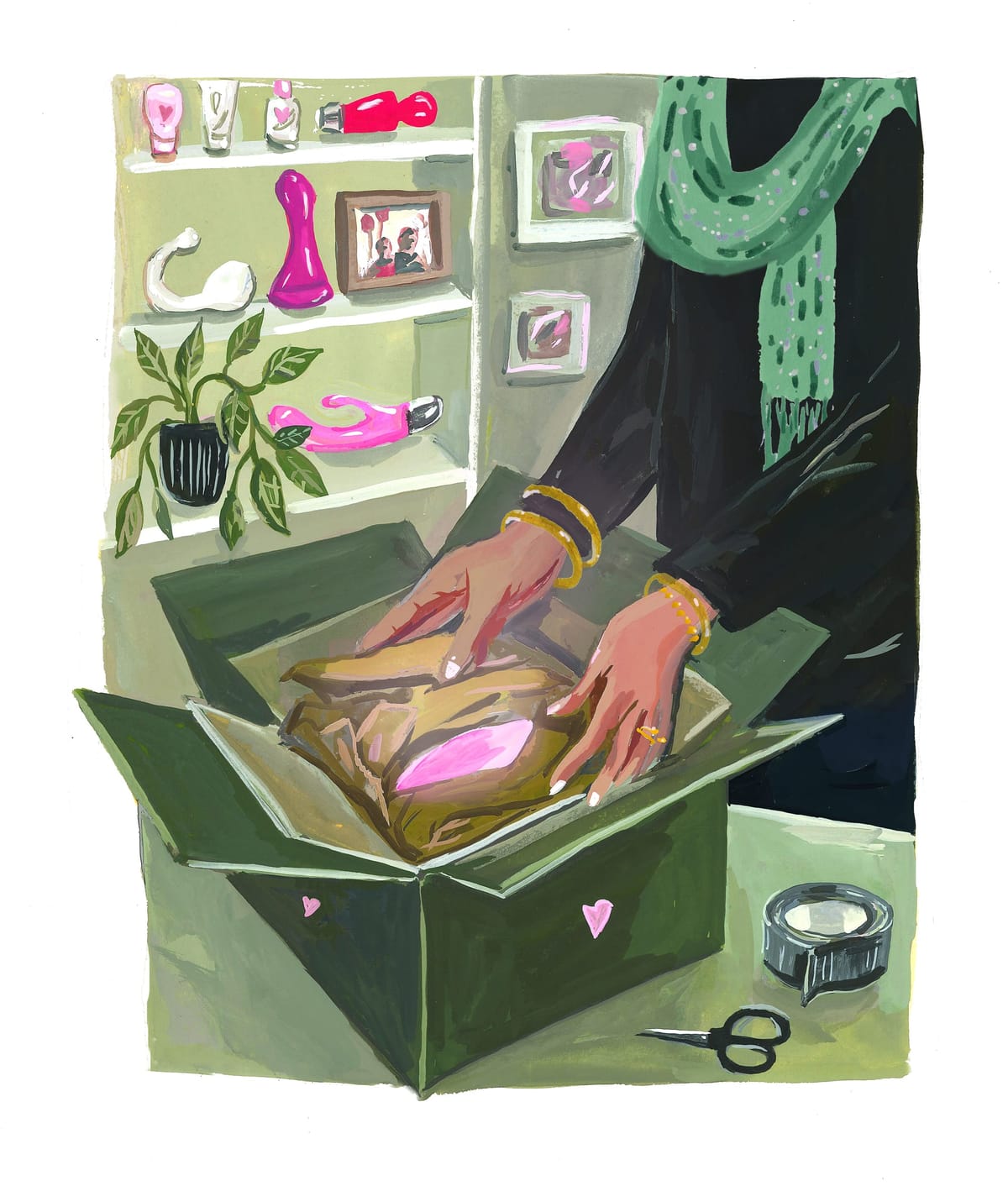
In 2023, she launched her own brand of sexual wellness products under the brand name Leezu’s. Her products include vibrators, massagers, colorful dildos, strokers and lube, all in bright shades and packaged neatly with playful instructions on how to use them.
All are available to buy directly online, for delivery in discreet plain packaging. Her tagline: “I refuse to feel guilty about pleasure!”
“After I used a vibrator for the first time, I was amazed that until that point I didn’t even know that I didn’t know how exactly my own body and pleasure worked and how easily and consistently I could experience pleasure,” she says.
“My pleasure had seemed mysterious to me til then, as I had never masturbated. It was like my third eye was opened and I felt like I needed to shout from the roof tops.”
The company was pushing at an open door. Until very recently, buying sex toys in India was all but impossible. Although there are no explicit laws against selling them, the country’s obscenity laws have frequently been used to restrict their import and sale. That’s because the definition of what counts as obscene is left up to law enforcement officials and the courts—meaning sellers of such products have no clarity about what’s legal and what’s not. Societal pressures have also contributed to the challenges of selling sex toys openly in India, where conservative values still hold sway.
“Sex toys are still viewed as objects that should be hidden away from any public display despite the fact that young and educated Indians are keen to use or even learn more about them,” said a 21-year-old female law student who asked not to be named.
“If lubricants and condoms can be [openly] sold, then why can’t sex toys?”
 Anne Quito
Where to buy? Good question
Because India has no brick-and-mortar sex shops, people had to buy sex toys overseas and risk an embarrassing public confiscation by overzealous customs officials at the airport before they became easily available online.
But the rise in e-commerce, which dramatically accelerated in India when everything shut down during the Covid pandemic, was a game-changer. Suddenly, it was possible to buy a vibrator with a lot less risk of public embarrassment. The anonymity e-commerce provided also meant there was less risk of business owners being fined or prosecuted by the authorities, who might face public pressure to shut down a brick-and-mortar sex shop.
That coincided with another trend in India—a rapid rise in online influencers, and with it, the increasing availability of information about sex and sexuality. Mangaldas started creating content focused on sex and sexual health in 2017, becoming one of the first women to put sex-positive content online in India.
Today Mangaldas has around three million subscribers across YouTube, Instagram, and Facebook. Her posts are light-hearted but straightforward, and tackle subjects many in India would still see as taboo, from masturbation to post-partum libido.
Many more have successfully joined the fray, among them Karishma Swarup, who posts under the handle “(the) talk you never got,” and the physician Tanaya Narendra, author of the best-selling book “Everything Nobody Tells You About Your Body,” who posts under the name dr_cuterus on Instagram.
 Ruchi Kumar
Sex stores proliferate in the online space
Leezu’s is now one of dozens of companies selling sex toys online in India. Another is The Sangya Project, which began five years ago at the height of the pandemic as an Instagram-based Indian sex-education project and has since moved into e-commerce.
Its founders—who include a wildlife conservationist and a lawyer with the Bombay High Court—saw a gap in the Indian market for products that came with guidance on use that was neither overly medicalized nor highly sensationalized, as had often been the case.
In an email, co-founder Aashish Mehrotra, who describes himself on his Instagram profile as “unabashedly queer, enthusiastically geeky,” describes the company’s approach as a cultural shift away from what he calls “loud, male-gaze-driven marketing that's exclusionary and sensational.”
“Our goal isn't just to sell toys,” adds co-founder Tanisha Rao. “It's to help people feel more at ease with their bodies, more curious about their pleasure, and more honest in their relationships over the course of their lives.”
More common than you’d think
A major study published last year in the medical journal, The Lancet found that almost half of Indians aged 18–45 now report using sex toys. Most of the more than 2,000 Indians surveyed for the study said they were aware of sex toys, with women and LGBTQ people aged 25 and over being most likely to have used them.
The report’s authors credited sexual wellness influencers with helping to raise awareness of sex toys, “from products addressing the ‘orgasm gap’ for women to products that promote and support safe, consensual, and playful sex for all genders and sexualities.”
In India’s major cities, which already tend to be more liberal, you can have a vibrator delivered to your home as easily as your groceries. Increasingly, women gift them to their friends for fun; men buy them for their partners.
It’s hard to make historic comparisons in the absence of reliable data. But given it was nearly impossible to buy sex toys in India until recently, it seems safe to assume awareness was once largely limited to those who had travelled overseas.
One executive at a sexual wellness company who asked to remain anonymous said sales are rising across the board because “Indians want to understand their own body before venturing out on dating apps or getting married.”
Yet even now, according to The Lancet report, India’s obscenity laws are sufficiently ambiguous to make sellers nervous. They may not be the only reason why vibrators tend to be disguised as lipsticks or pens, but they’re certainly a big part of it.
One company recently challenged a decision to block a consignment of goods customs officials deemed to be sex toys, even though they were labeled with more innocent-sounding terms like “massagers.” India’s courts, asked to adjudicate in cases like this, have asked the customs department to set fixed rules to end the inconsistency in how these products are treated.
Meanwhile, none of the companies The Persistent contacted were willing to speak about where their products are manufactured, an indication of how sensitive their business remains in India.
Still, sales figures suggest that people are circumventing official prudishness. A 2020 report found that sales of sex toys rose by 65% in India in the immediate aftermath of the Covid lockdown. Another report projects that the sex toy market in India will hit revenues of over a billion dollars by the year 2030.
Taking lessons from the Kama Sutra
Their popularity is nothing short of revolutionary in a country as conservative as India, where young women are shamed for wearing revealing clothing and women’s sexuality is so circumscribed that sex before marriage can be enough to incite families to murder (so-called honor killings).
Yet as Mangaldas observes, India has not always been reserved when it comes to sexual pleasure.
The “Kama Sutra” (which means “principles of love”) was written centuries ago, and remained celebrated in India for hundreds of years. And the vivid depictions of carnal pleasure carved on stone or as murals on the walls, domes of ancient temples, caves and Hindu texts provide ample evidence of a historic sophistication and acceptance in attitudes to sexuality.
Mangaldas is clear where, in her view, the blame for the change lies: India’s centuries of British colonization, culminating in the highly repressive Victorian era of the late 19th Century.
“Despite the fact that we’re the land of the Kama Sutra, as a society over the past at least 200 years, we’ve been conditioned to feel a lot of shame around sex,” she says.
“Most people desire a joyful and fulfilling sexual life. Unfortunately, the prudish and shame-laden Victorian lens around sexuality and the fear still endures in our society, and is still only beginning to be disrupted.”
R. K. Dhawan, a sexologist based in New Delhi, welcomed the change that campaigners like Mangadas have helped bring about.
“Indian consumers now have amazing choice,” he said. “They should have a lot of fun discovering a whole universe of products and scientifically accurate, judgment-free information and solutions for all their sexual wellness requirements.”
Yet he cautioned that this access was “still largely urban and class-specific,” limited mostly to the wealthy and educated. He called for it to be democratized.
“Pleasure is not a luxury,” said Dhawan. “It’s a part of health, dignity, and freedom.”