There’s a Lot the Skier Lindsey Vonn Can Teach Us. First Off, Know Thyself.
Lindsey Vonn’s comeback and crash are a reminder that women deserve to define their own limits.

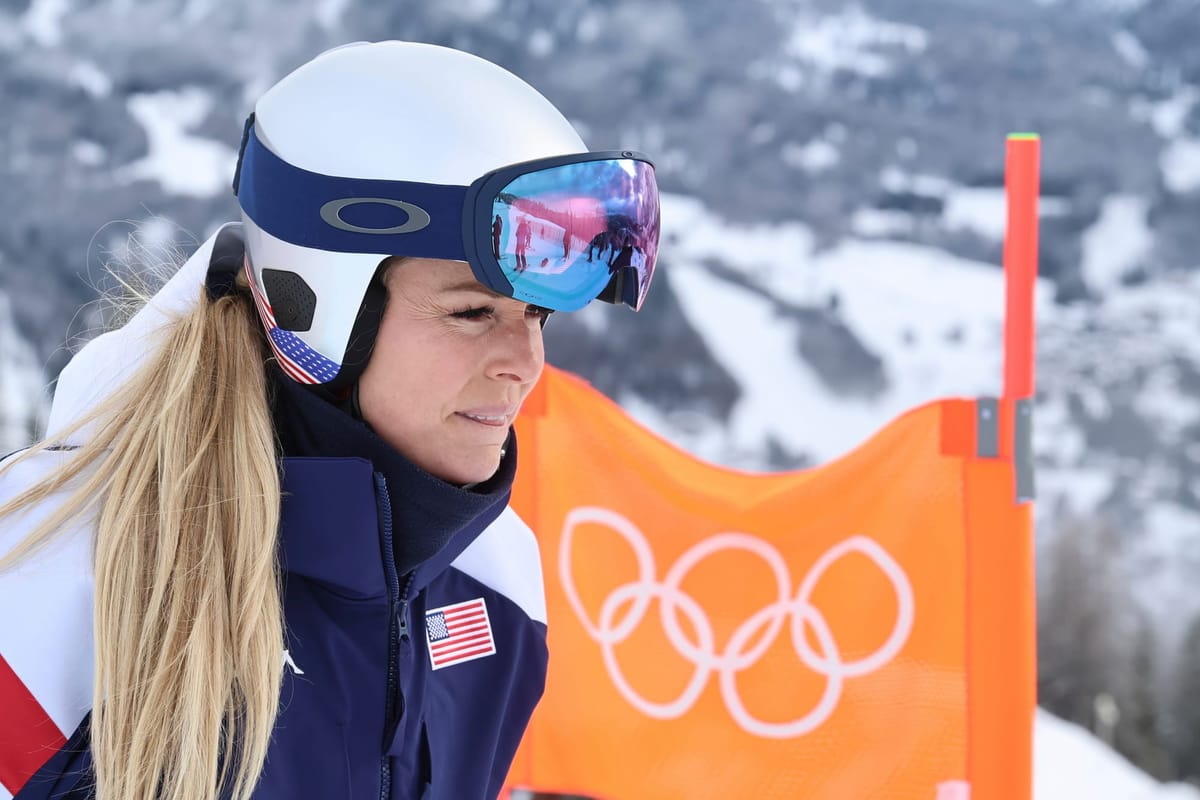
If Lindsey Vonn wasn’t on your radar before this weekend, she probably is now. She’s been on mine for years.
I grew up in rural Switzerland and one of my earliest memories is watching downhill skiing at our neighbors’ house—an old farm that was warmed in winter by a wood-burning stove that stretched from the kitchen to the living room.
The couple who lived there were elderly, lifelong villagers I treated like surrogate grandparents. They spent summers tending their fields and selling produce, and winters shoveling snow and watching skiing on a temperamental TV. That living room, dim and overheated, is where I first fell under the spell of the sport.
Downhill skiing might seem like a monotonous sport to captivate a restless child, but I was spellbound by the women and men who hurtled themselves down those icy slopes at more than 80 miles an hour. To me—an avid skier already—they were superhuman, and one day I knew I'd be an Olympic skier too.
You may be surprised to learn that I am, in fact, not.
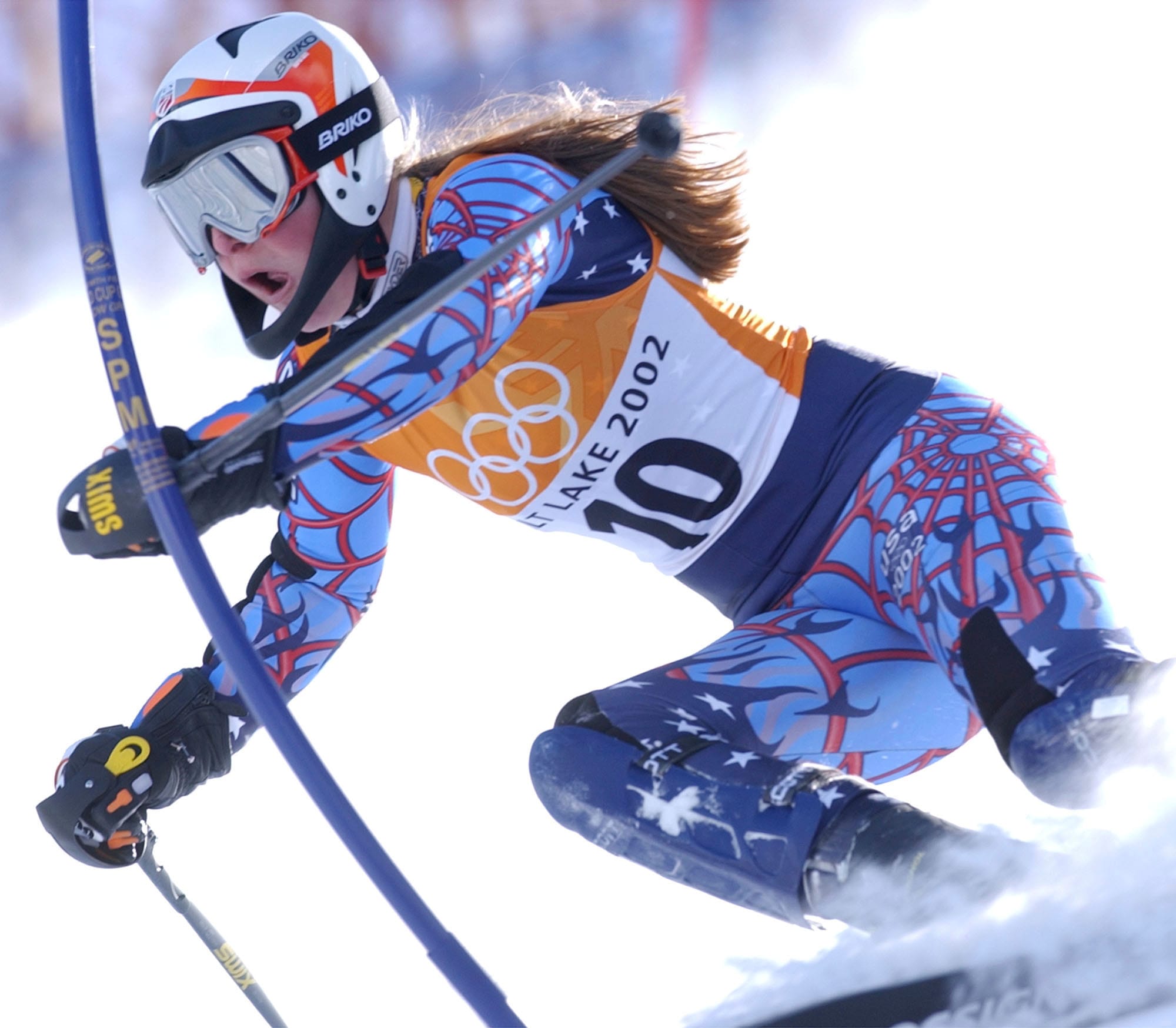
Around this time, the American skier Lindsey Vonn—then Lindsey Kildow—made her World Cup debut (2000), and her Olympic debut two years later. Meanwhile, I moved away from my rural village and my neighbors with their temperamental TV. Eventually, I’d move away from Switzerland.
I hung on to my habit of watching ski races when I could: I made an effort to watch Vonn’s early races (for reasons I couldn’t explain, she was the only non-Swiss person I rooted for) but soon life got in the way and I stopped watching skiing altogether. Vonn stayed vaguely on my radar, but I was hardly charting her every twist and turn.
When she became the first American woman to win gold in downhill skiing at the 2010 Olympics in Vancouver, I remember thinking how fantastic her muscular body looked, and then feeling intrigued that I—long marred by eating disorders and skewed perceptions of female beauty—considered her physique aspirational. Perhaps, I remember thinking, this is what healing feels like.
But even then, I couldn’t have told you much about Lindsey Vonn. I knew she was a stellar athlete. I knew she was winning races. I knew she lived a glamorous life, replete with red carpet appearances. And that was more or less it.
 Ruchika T. Malhotra
The pivot of all pivots

In 2019, when I read about Vonn’s plans to retire, I pretty much shrugged it off. She was, after all, 34—a perfectly reasonable age for an athlete to retire. Having won three Olympic medals—one gold and two bronze—and dozens of other races, no one would be able to blame her for wanting to rest on her laurels.
But then came November 2024, and the pivot of all pivots: One month after turning 40, Vonn announced she was back to skiing, back to training with the U.S. team, and soon would be back to racing again, too. Age? She seemed to be saying. I’ll show you what age means.
Vonn’s comeback was a spectacle to behold. In December 2025, on the pristine slopes of Switzerland’s St. Moritz resort, a 41-year-old Vonn became the oldest downhill World Cup winner of all time. “I think I was a little faster than I expected,” she understatedly told reporters after beating women decades her junior. “It's a very exciting time.”
Let us stop a moment here to put all of this in perspective. Research shows that elite, competitive skiing performance generally begins to decline for both women and men in their early 30s. Retirement around the age of 34 is typical. Before Vonn, the oldest person to win a downhill race had been Didier Cuche (incidentally, a Swiss skier who I also remember watching as a kid) in 2012 at age 37. The previous women’s record had been set by Federica Brignone at age 34. In other words, Vonn was a total anomaly. She wasn’t just shaking things up, she was defying the odds in the most spectacular way.
In the weeks leading up to the Winter Olympics, which kicked off last week in northern Italy, I kept my eye on Vonn. I couldn’t wait to watch her smash preconceptions about women in sports—about what could and couldn’t be done. So when she crashed during a race just a week before the Games and had to be airlifted off the mountain with a fully torn ACL, a ligament in her knee, I was gutted. Was this her Icarus moment? Had she pushed it too far? Was this a punishment for flying too close to the sun?
It was possible to ski with a torn ACL, but risky, physician experts pontificated in the media. But Vonn, yet again, proved she wasn’t going to live by shoulds or coulds. And if the assumption was that she’d pull out, well, she proved everyone wrong. “My knee is not swollen, and with the help of a knee brace, I am confident that I can compete on Sunday,” Vonn said at a news conference after the crash.
Compete she did, and many of us know what happened next.
Approximately 12.5 seconds into Vonn’s run—just as she was approaching a narrow chute between two walls of rock—it became evident, even to the untrained eye, that something was wrong. A split second later she was hurtling through the air. At first it looked like she was trying to regain control and correct her skewed trajectory. Soon she seemed to be bracing for impact. Finally, as she hit the snow, she cried out in pain. A helicopter was there within minutes and she was, once again, airlifted out.
At the time of writing, Vonn had undergone surgery for a broken leg. She is said to be in a stable condition. Her U.S. teammate Breezy Johnson went on to win the gold medal.
“Yesterday my Olympic dream did not finish the way I dreamt it would. It wasn’t a story book ending or a fairy tail, [sic] it was just life,” Vonn wrote on Instagram.
“I have no regrets,” she continued.
And then: “I hope if you take anything from my journey it’s that you all have the courage to dare greatly. Life is too short not to take chances on yourself. Because the only failure in life is not trying.”
 Rupam Jain
Judgement and agency
Throughout her entire career, but especially over the last few years, Vonn has embodied a wholehearted rebuke to the stereotypes that cling to women in sports. Vonn is a living counter-argument to the notion that women are somehow biologically or temperamentally unsuited for risk.
Her story is, of course, about perseverance. But I don’t think that’s all it’s about. It’s also about agency. It’s about that deeply personal calculus of knowing your body, your limits, your desires, and your tolerances. It’s about the radical act of deciding for yourself what you want and what you can risk, regardless of what anyone else assumes that decision should be. Would her risk have been my risk? Who cares? That’s not the point.
Remember when, in 2021, Simone Biles announced she was withdrawing from the Olympic all-around gymnastics competition, saying she wasn’t in the right mental place? Critics piled on (as did supporters), as if Biles’ decision had anything to do with them. It might be tempting to see Biles and Vonn as opposites: one pushing on while the other pulled out. But I see them as examples of the same thing: Two women determining for themselves what the right course of action is, experts and media commentators and all the rest of us be damned.

Both women squarely rejected the idea that their body or their career exists to satisfy a public script. Both refused to be drafted into narratives about toughness. Was Vonn’s decision to race in Cortina on Sunday the right one? There’s only one person in the world who’s entitled to answer that question. Or, as the organizational psychologist Adam Grant so pertinently put it on social media on Sunday: “Dear @lindseyvonn critics: kindly shut up and go back to your couch.”
It’s tempting to cast women athletes into archetypes because women’s sports are still policed by so many contradictory expectations: Be strong, but not too strong. Be fearless, but not reckless. Be committed, but not selfish. Be inspirational, but not complicated. Vonn and Biles both violate these expectations simply by being themselves. They compete not as metaphors but as nuanced individuals.
Now, in retrospect, I can see it: When I first started watching Vonn in my teenage years it’s clear I wasn’t just watching a skier; I was watching someone who was actually modeling—whether she knew it at the time or not—a kind of self-trust I wouldn’t learn to claim for myself until much later.
Maybe that’s why Vonn’s story feels personal. She reminds me that a woman’s power doesn’t come from pushing through or stepping back, but from knowing, in any given moment, exactly what has to be done—and knowing too, that in any given moment that might change completely. No justifying or explaining required.
 Emma Haslett