The Radically Honest Out-of-Office Message
Women are swapping corporate niceties for real talk. It’s more than just a charming stunt; it’s a brilliant act of microfeminism.


“I’m out of office because I’m a single mom paying $3,000 for childcare with no paid leave to fall back on,” Adrianne, a 40-year-old public-relations professional from New York City, recently wrote in her out-of-office email auto-reply, according to an article in Marie Claire.
Adrianne’s note might seem refreshing, but it’s not that unique. In recent weeks, a micro-trend—documented on social media—has been quietly spreading through professional inboxes. Women across a slew of industries and job types in the U.S. are posting radically honest out-of-office messages that cast a clear, often unforgiving, light on the still largely unacknowledged realities of juggling work, life, and everything in between.
Instead of the typical polite, neutral, and frequently impersonal lines about “limited access to email” or “replying upon my return,” these messages step out from behind corporate decorum. They call out burnout, childcare crises, emotional overload, and the obvious and essential truth that humans are not—and never were—meant to operate as machines. Some mention mental-health days; others confess exhaustion or just a dire need for rest. Still others reel off dizzying to-do lists. They’re all different but the subtext is common; that the world of work is broken.
The campaign is the brainchild of Paid Leave For All, an organization fighting to win paid family and medical leave for all working people. Starting on Nov. 25, the group took to social media to call on people to “set their real Out of Office replies to reflect the care responsibilities that pull them away from work, sometimes permanently—and to share those messages publicly.”
 Phoebe Gavin
Hey, Francesca here, editor of The Persistent. If you've been reading us for free these past few months, it might be time to upgrade your subscription to paid, so we can keep publishing pieces like these and you can stop getting messages like this.
“While many of these messages have some humor,” said Dawn Huckelbridge, founding director of Paid Leave for All, “they remind us that care is the backbone of this country—and that it’s past time the U.S. passed paid leave.”
On Instagram, Huckelbridge posted a picture of her own OOO message. “Thanks for your note!” it wrote. “I’m out of office because I have a son who I want to be present for and parents who want to spend their later years with family (and will need an advocate navigating treatments),” she added. “I’m lucky I can do this, even though it’s still hard with the costs of care in this country. Only 1 in 4 of us even have paid family leave from our jobs, millions lack a single paid sick leave (hello, flu season).”
On LinkedIn, Ai-jen Poo, a labor activist and president of the National Domestic Workers Alliance, chimed in, posting a picture of hers: “Hi! Thank you so much for your message. I’m #OutofOfficeForCare because I need to pick up my kid from school, and my mother-in-law is in memory care and needs my support, and it’s also getting colder and I’m pretty tired.”
 Paula Derrow
Reclaiming Space
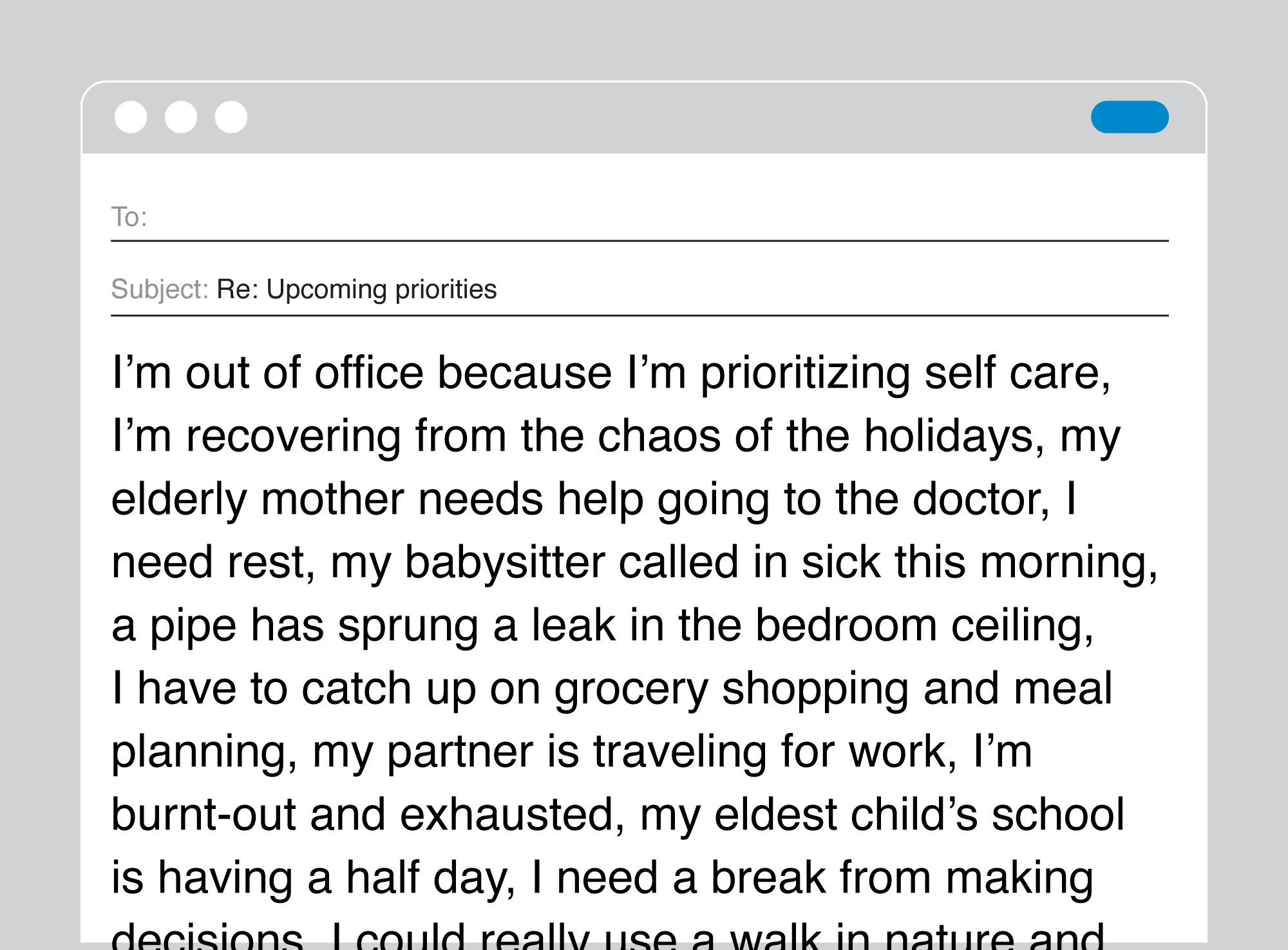
Part of the appeal of the campaign lies in its shock value. There’s something brilliant about a woman who shrugs off convention and broadcasts the technicolor truth in the normally anodyne channels of office communication.
But there’s something weighty, steady, and possibly even hopeful about it too, especially amid headlines about women in the workforce that make us feel devoid of hope. (Remember, about half a million women have dropped out of the U.S. labor market since January.)
Because at its core, this trend is about reclaiming space in a work culture that has long equated worth with perpetual availability and unsustainable presenteeism. (If you don’t know what I’m referring to, look up Claudia Goldin’s Nobel Prize-winning research on greedy work.) For women—who, as we all know, frequently shoulder the heaviest loads of caregiving and emotional labor—the out-of-office message is one of the few places to drop the façade and pretense in a way that’s hard to ignore. A line like, “I’m unplugging because I need a break and I’m honoring that,” far from being a mere logistical note becomes an act of rebellion. And it’s particularly telling in a labor market in which the fear of job loss is real and palpable—in which being able to tolerate the risk of being laid off for speaking out could be framed as a luxury.
The possible ripple effect matters, too. When one woman names her limits, she is, in a way, giving others permission to do the same. She’s normalizing saying, “I’ve had enough for now; I just need a moment.” These messages challenge the staid idea that professionalism requires the erasure of the self. In their place, transparency emerges as a form of power—a preparedness to recognize one’s limits and a refusal to apologize for having them.
As Lauren Smith Brody, the chief executive officer of The Fifth Trimester and co-founder Chamber of Mothers, put it to me, “Having to be away from email for care can feel—ridiculously, but still!—like a personal failing, but when other people normalize that need, we can collectively realize: It's not me, it's the system.”
So yes, radically honest OOO messages might be dismissed as somewhat trivial jabs at all that’s wrong in the world of work, but they’re also a brilliant form of microfeminism. Could they even eventually provide the whiff of a cultural shift? A move toward workplaces that value truth over performance, boundaries over burnout, and people over productivity?
I’m not sure, but it’s certainly worth a try.
 Molly Dickens