Who Invented Women’s History Month? I’m Glad You Asked.
Before they became marketing opportunities, International Women’s Day and Women’s History Month were milestones in a much longer and larger struggle.


Every year it happens like clockwork: In mid-February, dozens of emails flood my inbox. “International Women’s Day is coming up!” a press release might announce ahead of March 8, alongside a steady stream of invitations to “join us for a panel discussion about empowerment!” and “listen to a livestream on the state of parity!”
Banks, law firms, corporates, ad agencies, are all eager to mark the day, or even the whole month of March, which is Women’s History Month—when the world briefly remembers that gender equality is not only important, but exceptionally marketable. Needless to say, I feel mixed about the occasion.
On one hand, I’ll embrace any excuse to celebrate women—their achievements, their legacies, their futures. On the other, do we really need a designated day or month to do so? It carries the not-so-faint suggestion that during the remaining eleven months, it’s acceptable for those celebrations to fade into the background.
Over time, my cynicism has only grown. “Femvertising”—a marketing strategy that wraps products in a language of empowerment—can be especially grim. It’s often deployed by companies with no real connection to women’s rights, and in some cases, by companies whose track records actively undermine them.
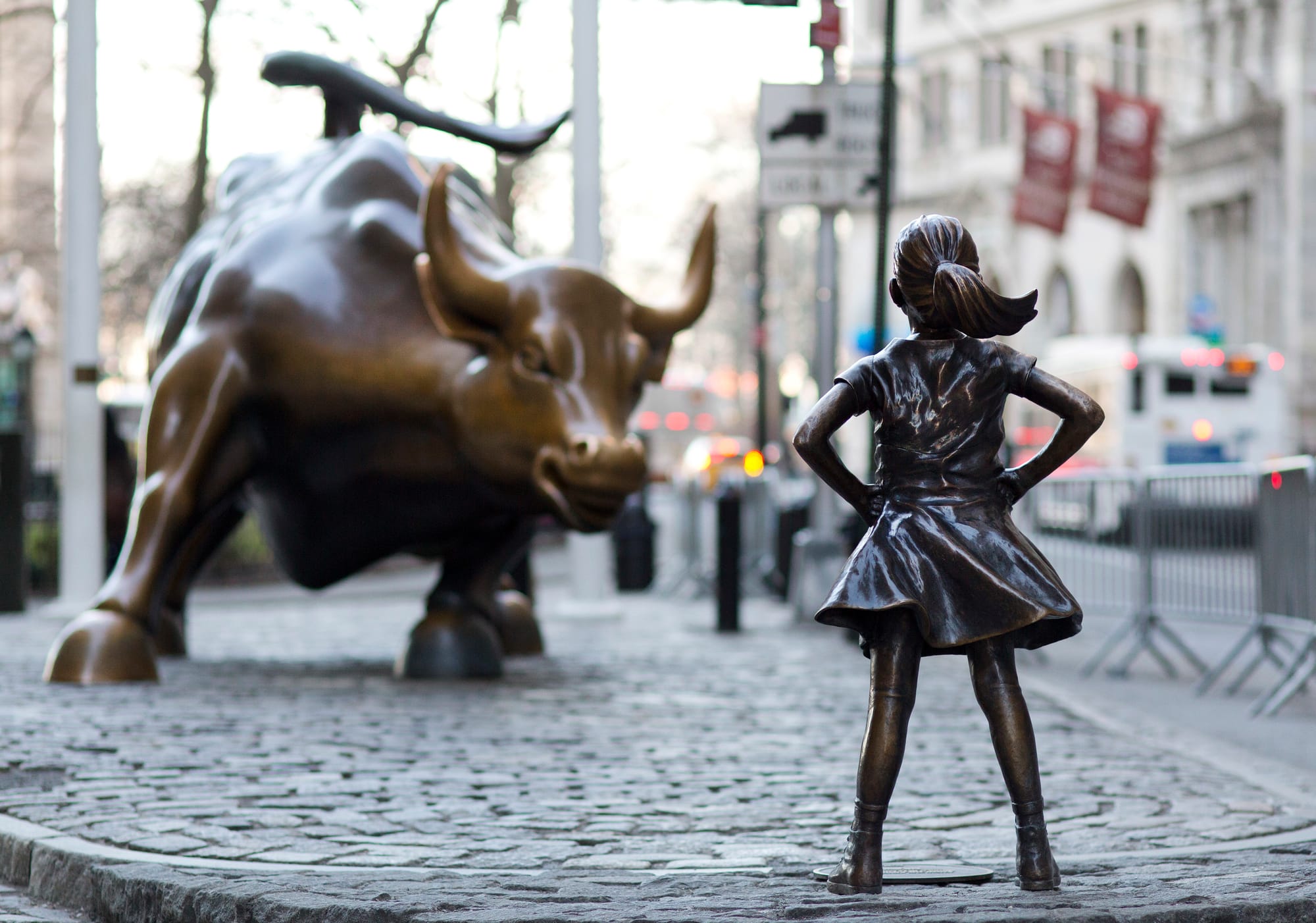
In 2017, I remember the fanfare around the unveiling of State Street’s “Fearless Girl” statue near Wall Street. She stands defiantly with a plaque, urging anyone who passes by to “Know the power of women in leadership.”
That same year, the very same State Street paid $5 million to settle allegations it had systematically underpaid its female senior executives. The dissonance was hard to ignore.
Another example springs to mind: a 2017 Super Bowl commercial from the German carmaker Audi in which a father watches his daughter race a go-kart while he frets over the barriers she’ll inevitably face in life simply because she’s a girl. The message is meant to underscore the company’s commitment to gender equality. Unfortunately, the one thing I couldn’t stop thinking about as I watched it was that, at the time, Audi’s six-member board did not include a single woman. (And by the way, nine years on, nothing’s changed in that respect).
More recently, I’ve made a habit of doing a bit of due diligence whenever I see a consumer brand incorporating Women’s History Month into its advertising. Target? Just four out of 14 members of its board of directors and management team are women. Amazon? Five out of its 19 directors and executives are women. Walmart crows on its website how it loves celebrating its women employees in March. “The month is about recognizing women’s vital role in American history and growth,” it states. Only, just three of its 14-person board of directors are women. Its executive council has two women on it and eight men.
In short, virtue signalling is real and everywhere, especially during Women’s History Month and International Women’s Day.
And yet, beneath all this, it’s worth remembering something else: Before they became marketing opportunities, these designations were milestones in a much longer and larger struggle—a fight for improved working conditions, suffrage, political representation; and an overall manifestation of disenfranchisement and frustration. Indeed, they emerged from genuine activism at a time when the fight for women’s rights was even more precarious than it is today.
Deep Roots
The roots of International Women’s Day stretch back more than a century.
The early 1900s were a time of upheaval as women across the United States began organizing against exploitative labor conditions and the denial of basic rights: workplaces were frequently unsafe and unsanitary, and hours were punishing.
In 1909, garment workers in New York City, mostly women, staged a massive strike over long hours, low pay, and dangerous factories—an action known as the “Uprising of the 20,000.”
Two years later, in 1911, the horrific Triangle Shirtwaist Factory fire exposed exactly how deadly those conditions were. On March 25, a fire broke out at the factory—which was housed in a 10-storey building too tall for firefighters to reach with their ladders. The owners of the factory had locked the emergency exit doors in the building, leaving desperate workers to leap to their deaths and others to perish in the blazing inferno. The fire lasted a mere half an hour, but claimed 146 lives.
Terrible working conditions were not rare at that time. Indeed, hundreds of workers are believed to have died every day on the job, but the speed and brutality of the fire captured the public’s attention, galvanizing reform.
Meanwhile, over in Europe, similar movements were taking shape, with women demanding the right to safe working conditions, better pay and the right to unionize.
 Josie Cox
A Transatlantic Change
The seed of what is now International Women’s Day was planted at a conference in Copenhagen in 1910, when the activist Clara Zetkin proposed an annual “Women’s Day” to champion voting rights and political participation. From there, the idea spread quickly, broadening in scope and geography.
By 1911, more than a million people had joined demonstrations across Europe and in 1917, in the Russian capital of Petrograd—today known as Saint Petersburg— tens of thousands of people, mainly women, congregated on the historic Nevsky Prospekt avenue.
“Feed the children of the defenders of the motherland,” one banner read. “Supplement the ration of soldiers’ families, defenders of freedom and the people’s peace,” was scrawled on another.
The city’s governor at the time described the crowd as varied: “ladies from society, lots more peasant women, student girls.” In other words, the revolution was beginning and women were striking the match. Later, that day would be widely recognized as a pivotal moment that unleashed the Russian Revolution and sent ripples of political upheaval across the continent and beyond.
In 1922, Vladimir Lenin, the head of government of Soviet Russia, officially designated March 8 as International Women's Day—or International Working Women's Day—in the Soviet Union to honor the role women played in the 1917 Russian Revolution.
A Day, a Week, a Month
Despite all of this momentum, it wasn’t until the 1970s that March 8—its contemporary meaning and symbolism, replete with feminist greetings cards, special deals at the grocery store and plenty of events across all sorts of institutions—took on the global form we recognize today. In 1977, the United Nations recognized International Women’s Day, declaring it a day dedicated to women’s rights and world peace and encouraging countries worldwide to observe it.
In the U.S., that momentum continued. What began in 1978 as Women’s History Week in California’s Sonoma County—timed deliberately around March 8—expanded rapidly. A national proclamation followed in 1980.
“American women of every race, creed and ethnic background helped found and build our Nation in countless recorded and unrecorded ways,” the proclamation reads. “As leaders in public affairs, American women not only worked to secure their own rights of suffrage and equal opportunity but also were principal advocates in the abolitionist, temperance, mental health reform, industrial labor and social reform movements, as well as the modern civil rights movement.”
On Feb. 28, 1980, President Jimmy Carter, in a statement, urged Americans to recognize women’s contributions to history, noting that “from the first settlers who came to our shores, from the first American Indian families who befriended them, men and women have worked together to build this Nation.” He added that “too often, the women were unsung and sometimes their contributions went unnoticed,” but that “the achievements, leadership, courage, strength, and love of the women who built America was as vital as that of the men whose names we know so well.”
In 1987, Congress officially designated March Women’s History Month, and President Ronald Reagan chimed in thus: “Historians today stress all that women have meant to our national life, but the rest of us too should remember, with pride and gratitude, the achievements of women throughout American history.” Now it wasn’t just a day, it was a whole month.
 Josie Cox
A Bitter Backdrop
All of which brings us to today. As we consider International Women’s Day and Women’s History Month—those who fought for it, those who praised it, those who have celebrated it and those who honor it—we also have to consider the current, painful state of affairs.
In many countries around the world, women’s rights are regressing. Reproductive freedom is under attack. In the U.S., the gender pay gap is widening while women of color are enduring an unemployment crisis and misogyny is being normalized at the very top of organizations and institutions.
In the shadow of all of this, the cynicism I feel about these celebratory moments and markers and the way they’re used and abused—sometimes for commercial gain, sometimes for simple PR purposes—sort of fades into the background. It almost feels irrelevant. In this environment of fear and threat, of backlashes against anything that so much as hints of “DEI,” part of me feels grateful to anyone bold enough who speaks out for women’s rights. Yes, even if one of the incentives for doing so is the bottom line.
And as my inbox fills with banners, brunches, and branded hashtags, I’ll try to remember that International Women’s Day and Women’s History Month weren’t dreamed up in corporate boardrooms.
They were forged on both sides of the Atlantic by so much more than that: through protest, solidarity, and the determination of generations who insisted that women’s stories belonged at the center of history, not on the margins. That took courage. Maybe the least we can do is honor that courage by carrying forward what they started.
 Josie Cox