How to (Re)Discover Your Identity Outside of Work
There's a particular combination of fear, insecurity, and doubt that shows up when you know your current professional chapter has come to an end, but you can't imagine what's next.

Have you ever wondered what it does to children when we ask them what they want to “be” when they grow up?
We’re not asking who they want to become, we’re asking what job they plan to have. From a very early age, we teach kids that their identity is their occupation.
Often that “what do you want to be” question follows kids all the way through school, with academic courses chosen for practicality, not joy or curiosity. In college, the first question when you meet someone new is often “What’s your major?” One’s future is discussed almost entirely in terms of jobs, with a sprinkle of marriage and kids.
In adulthood, “What’s your major?” morphs into "What do you do?” and the answer is still about occupations. The answer feels existentially important because titles and employers become shorthand for legitimacy, intelligence, ambition, and worth. Subconsciously or not, most of us assign assumptions to others—and ourselves—based on the answer.
I’m not a sociologist or a psychologist; I’m a career coach. But in my work, I routinely hear women in their 30s and 40s say, in moments of career distress, “I don’t know what I want to be when I grow up.”
Of course, these women are already grown. They are already themselves. But the phrasing is the shorthand they use to describe feeling disconnected from their sense of self due to career uncertainty.
There's a particular combination of fear, insecurity, and self-doubt that shows up when you know your current professional chapter has come to an end, but you can't imagine what's next.
It might sound like:
- "I just don't know if I can do anything else."
- "Is my experience even valuable elsewhere?"
- "Have I wasted the last 10 years on the wrong career?"
- "I can't imagine taking a huge step back or starting over."
It can feel paralyzing, like being trapped inside a version of your life you don't want. But I promise there’s an escape hatch—it's just a little unexpected. It involves developing an identity separate from your work.
Work, work, work, (and maybe caregiving)
Career pivoters will usually ask me for ideas for where to take their skills, hoping I can give them a magic list of options that solves their feeling of stuckness. Yet the moment we start exploring the alternatives, they hit the same emotional wall: “I just can't see it.”
When your entire adult life has revolved around work, your sense of self becomes so tightly fused with your professional profile that change feels unimaginable. This "identity enmeshment"—the idea that you are your job and your job is you makes every other option feel risky, costly, or even impossible.
A certain amount of identity enmeshment is normal and unavoidable. In the U.S. we live in a culture that bombards us with messages about the importance and moral value of work. But women who have paralyzing identity enmeshment tend to have something in common.
When we dig into how they spend their time, who they spend it with, and where they express their values, the answer is almost always the same: work, work, work. Oh, and maybe caregiving.
If work is the foundation of your social and intellectual landscape, of course, the prospect of a radical career switch would shake you to your core.
 Luba Kassova
How to rediscover who you really are
If work and/or caregiving roles have become the primary architecture of your identity, a few casual conversations with people in other industries isn't going to be enough to help you figure out what your next career move should be. You need to start recalibrating your everyday life so it helps you build and maintain a more dimensional sense of self.
The first step is to think more expansively about professional possibilities. Take active steps to diversify the way you spend your time, who you spend it with, and what makes those activities meaningful to you. Essentially, you need to develop a personality beyond work.
This is not an easy thing to do. Culturally, women tend to be rewarded for what we do for others: our partners, our children, our parents, our employers, and so on. Women tend to be penalized—implicitly or explicitly—when we claim time, energy, or enjoyment for ourselves. Even thinking about what we might want can riddle us with guilt.
Start by claiming small, regular pockets of time for things that aren't for work or family. Consistency matters because your sense of self is built through repeatedly choosing yourself. Even tiny investments in yourself will pay off over time.
 Kathleen Davis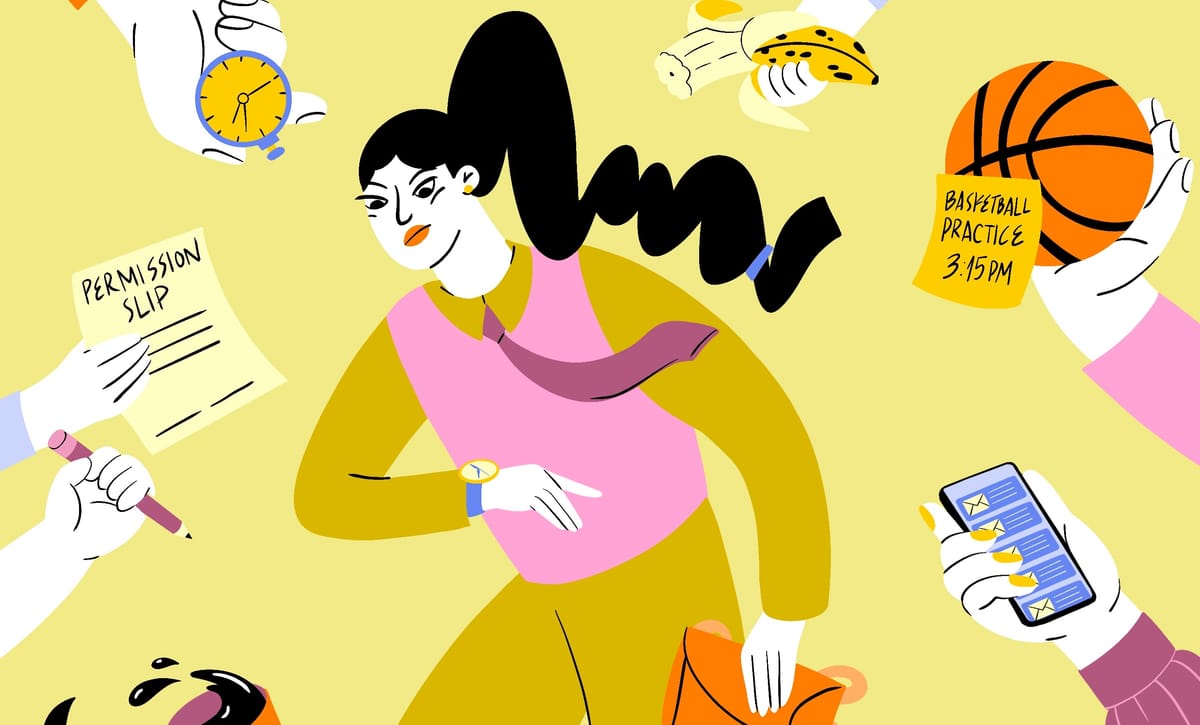
Diversify your identity by diversifying your time
The way to loosen identity enmeshment is to invest in relationships and activities that aren't connected to your professional or domestic roles. The more you can reclaim, the better.
Scroll through your contacts and look for someone who has nothing to do with your industry or current job. Send a text, "I thought of you. It's been ages. How are you?" You're restarting a relationship, but you're also reclaiming another version of yourself: the friend.
Of course, you may look at your contacts and realize there is no one outside the professional realm you actually want to talk to. If that's you, your next best entry point is a hobby. Something you do for the joy of it, not because it's productive or income-generating.
A hobby is a triple threat against identity enmeshment. It lets you experience pleasure and build competence in ways that have nothing to do with work, which reclaims time. And because most interests come with ready-made communities, online or otherwise, it's easy to make friends who enjoy what you enjoy. Just make a point of not talking about work at all.
A hobby can give you a way to express and explore your values. You can support a cause, practice a craft that connects to something meaningful to you, or join a community organized around the issues you care about.
 Phoebe Gavin
What changes when work isn't your everything
When your identity is tightly fused to your job, you tend to experience everything at work as intensely personal. A difficult conversation, unclear expectations, mistakes, unfair treatment—all of it feels like a referendum on who you are as a person. The stress doesn’t stay at the office; it follows you home, spills into your relationships, and haunts you even in your off hours.
When you start to disentangle your professional persona from your identity, work itself starts to feel less emotionally threatening.
Then work problems stay where they should—at work. And even in the worst-case scenario, such as a job loss, it remains a practical challenge, not a crisis of identity.
Over time, this shift in thinking can change how you relate not just to your career and your title (or lack thereof), but to yourself. You can become more resilient. More flexible. Less afraid of change.
That’s the deeper payoff of developing a personality outside of work: You’ll have the freedom to experience yourself as more than what you produce and to let work be one of many meaningful parts of your life, not just the one thing that defines it.