The Women Bringing Witchcraft Into the Workplace
A growing cadre of career consultants, creative agencies and entrepreneurs are using witchy “dark arts” like Tarot cards and crystals to help their clients fulfill their dreams/find their focus…

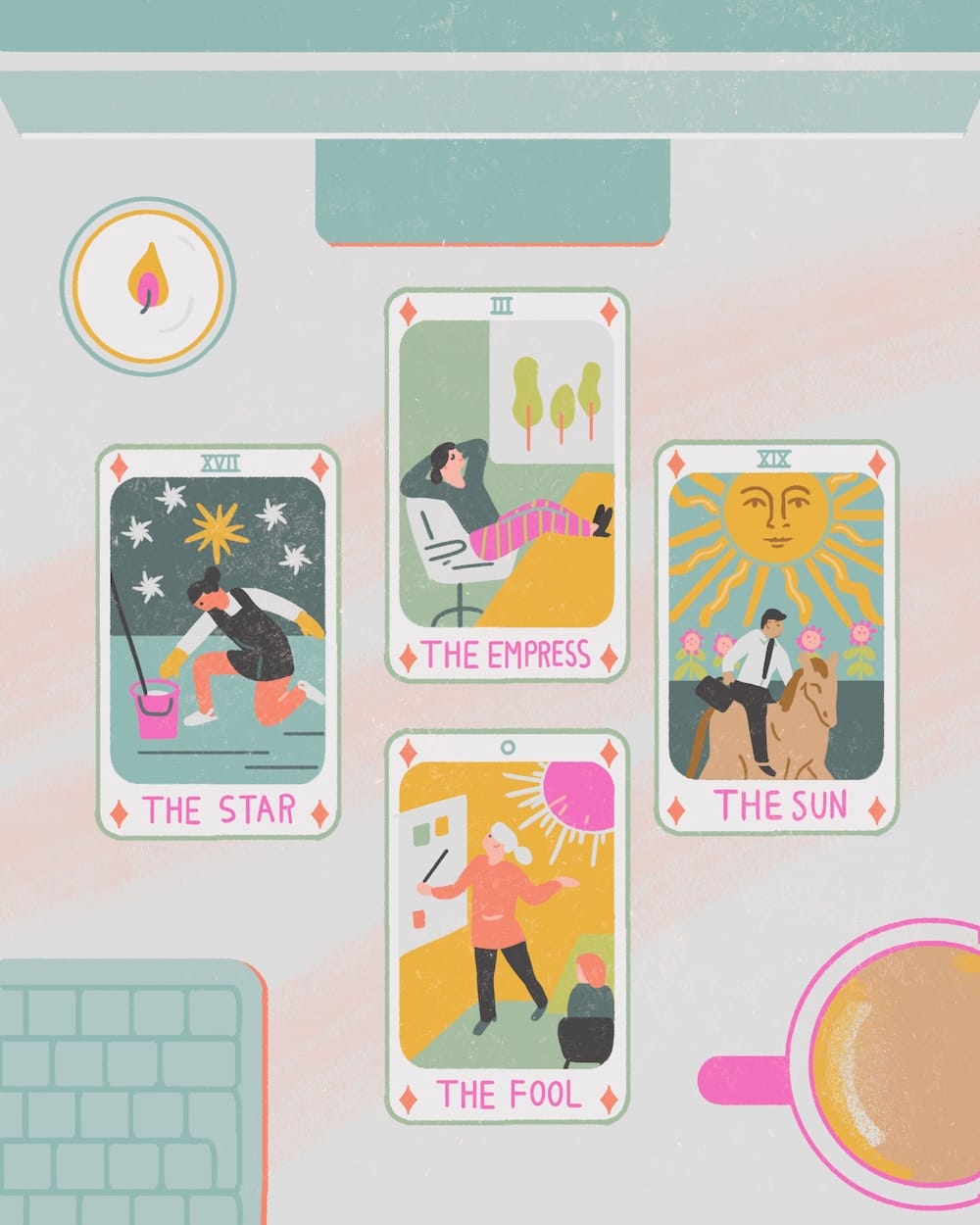
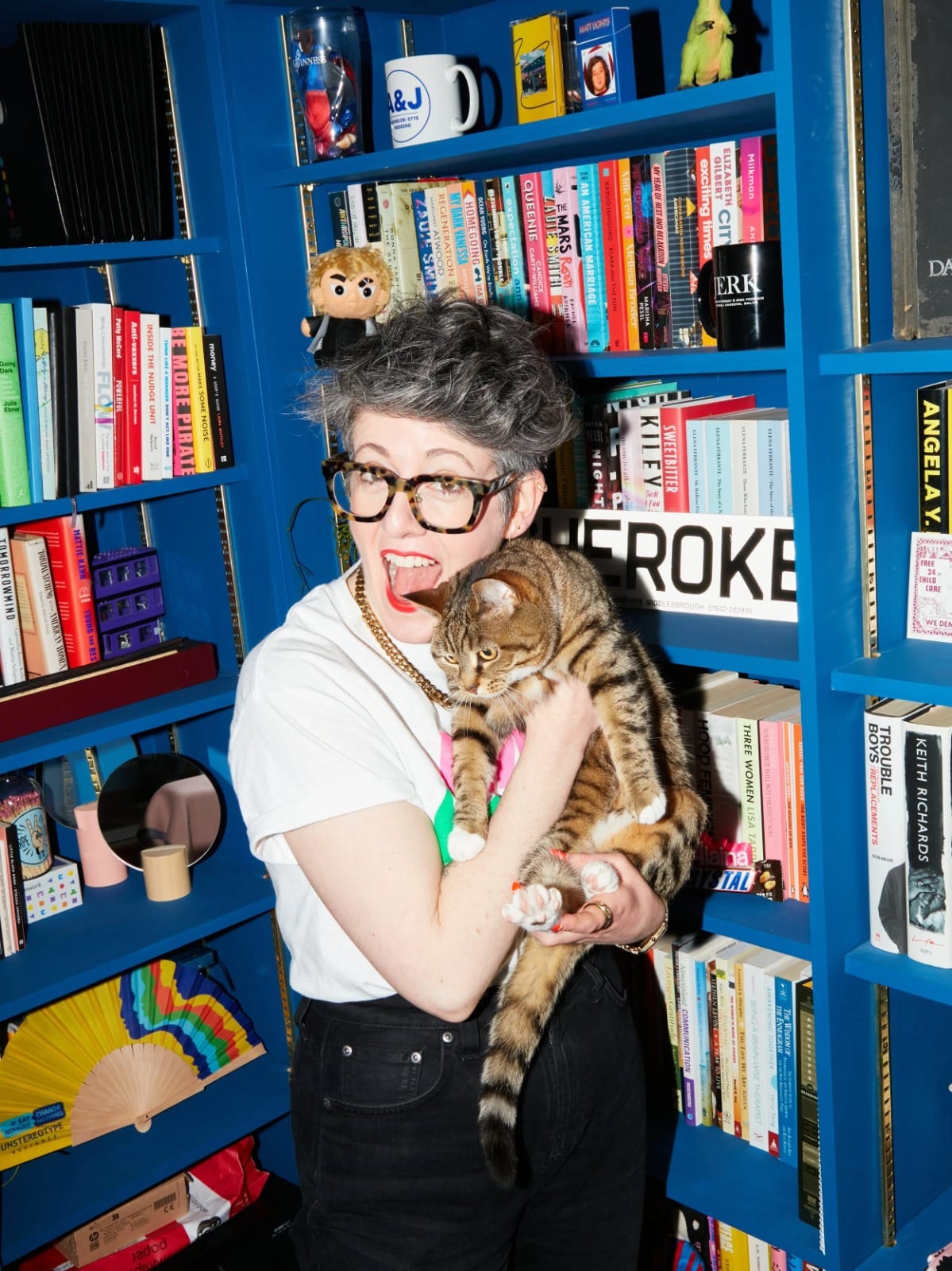
I’ve never been a very woo-woo kind of person. But somehow, on a crisp January morning, I found myself sitting in the home office of the aptly named Alaina Crystal, a feminist brand strategist, life coach and self-professed “baby witch.”
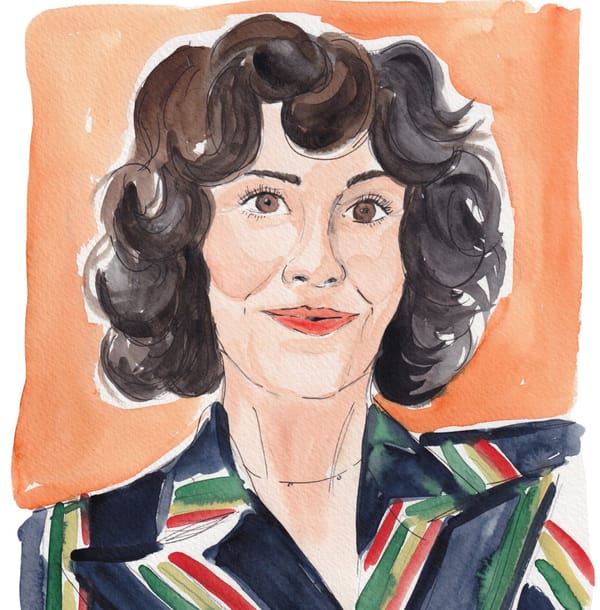
Thankfully she wasn’t wearing a pointy hat and there were no broomsticks in sight—in fact, with her hipster salt and pepper pompadour, colorful clothing and bold leopard-print glasses, she looked like she could fit right in at a Madison Avenue ad agency.
Crystal is the founder of Coven in the Corner Office, a Substack and podcast dedicated to “putting the woo in work.” Her own workspace—located in the English seaside town of Broadstairs—is as bright as her clothes. There’s a candy pink fireplace and cobalt bookshelves filled with bright-spined books, including “Three Women,” a bestseller by Lisa Taddeo; and “Be More Pirate,” a business book about ripping up the rules. On one wall, there’s a neon light that trumpets “girls, girls, girls.”
I’m not likely to start carrying crystals in my laptop bag, nor burn sage to clear the air after a toxic Zoom meeting, but I certainly felt a bit spellbound when Crystal began shuffling a deck of Tarot and asked: “Do you have anything you’d like to ask the cards?”
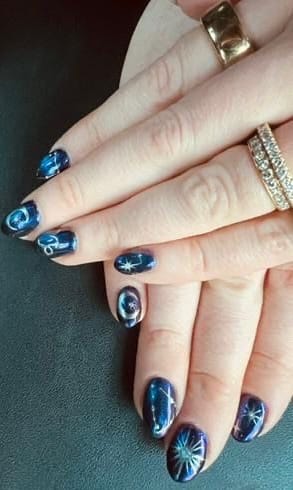
As it happens, I did. As she pulled three tarot cards for me, I noticed her blue zodiac nails, another indicator of the woo about to happen. Tarot, for the uninitiated, is a system of symbolic cards, traditionally thought to be used for divination but increasingly seen as a tool for reflection. Each card represents either big life themes or everyday situations that encourage self-examination.
For instance, the tarot card reader might ask you to hold a question in your head as they shuffle the deck and draw one or more cards, which can appear upside down or right side up. Each card is said to have its own meaning—sometimes more nuanced than the obvious answer—The Fool card, for instance, is said to represent new beginnings, innocent potential, spontaneity, and leaps of faith.
I asked the cards something that has plagued many a waking hour for the past 12 months: Should I keep doing what I’m doing (working as a freelance writer and taking every gig that comes my way), retrain in something more AI-proof, or plow my energy into my pre-existing side hustle—my infertility podcast, Big Fat Negative?
The kind of pagan-esque spirituality Crystal offers is having a moment. Not only on social media (for example, #WitchTok has 9.1 million posts on TikTok) and in the selfcare/beauty industry where there is near constant talk about “rituals” – but, surprisingly, in the corporate workplace. Listen to Crystal’s podcast and you’ll hear tales of people using spiritual practice to make business decisions, prepare for meetings and help employees work better together.
“I think the appeal has a lot to do with burnout culture,” says Crystal. “Our nervous systems are not in a good place—we’re under a lot of pressure, and in the post pandemic era, we’re searching for something to help us make sense of what the f**k is happening. We can’t control the things we see on the news. Spirituality gives us a sense of ritual, a sense of control and a connection to self.”
Breathwork, yoga…and sage
Kate Glover, the founder of the consulting firm Brighter Club describes herself as a “put my crystals outside to charge in the full moon” kind of girl. And she brings that sensibility into her work with clients—yes corporate clients—such as TikTok and WeWork. Both of these companies have hired her to improve performance and wellbeing in their offices. In practice, this means sessions focusing on reframing challenges, clarifying purpose, managing pressure and, well, breathing.
Sometimes Glover might leave crystals on people’s chairs or use palo santo (which, similar to sage, is burned in indigenous rituals) to clear any negative energies from office spaces. The purpose of her consulting business, she says, is to change work culture and “create a movement for everyday positivity”—ideally, breaking people out of their everyday grind with mindful practices.
“It’s about introducing people to tools or practices that help them feel empowered in their own lives,” she explains. “Things they can use before they burn out to the point of being broken.”
But while Glover sees huge benefits to bringing these kinds of rituals into the workplace—with clients saying her sessions are “genuinely special” and “refreshingly authentic and accessible,” she always tests the water first.
“With corporate groups, I do discovery sessions ahead of time to ask how open the teams are to things like movement, sound and scent work. I need to know how far I can take the woo-woo.”
 Caroline Fairchild
A career pivot thanks to Tarot
As for Crystal, who started her career in brand strategy (sans tarot), she experienced a pivotal moment at a women’s leadership lunch in Cannes last year. Her brand strategy business was in a difficult position; a client had just cancelled a sizable contract. Attending the Cannes conference would be pricey, but she decided to take the risk. “When I got there, I started shuffling tarot cards, which I sometimes do when I’m anxious. Someone spotted me and asked if I would pull some cards for them. Next thing I knew I had a queue.”
After her impromptu tarot session, the response was so enthusiastic that she realized the cards could sit nicely alongside the career coaching work she was already doing on the side of her brand work. As an observer put it about Crystal bringing Tarot to one of the world’s biggest advertising conferences: “You’re doing the goddess’s work of further dismantling Mad-Men like toxic culture–and making space for magic….”
But while there is certainly an air of magic in her techniques, Crystal says that when she sits down with people and asks if they have questions for the cards, they quickly get practical. More often than not, they ask about career transitions, which is not surprising given our volatile world economy. “What I’ve found is that the cards can be a beautiful tool to encourage people to open up. They’re also brilliant for decision fatigue. They don’t predict the future. They’re more of a portal to the subconscious.”
‘Flying daggers’
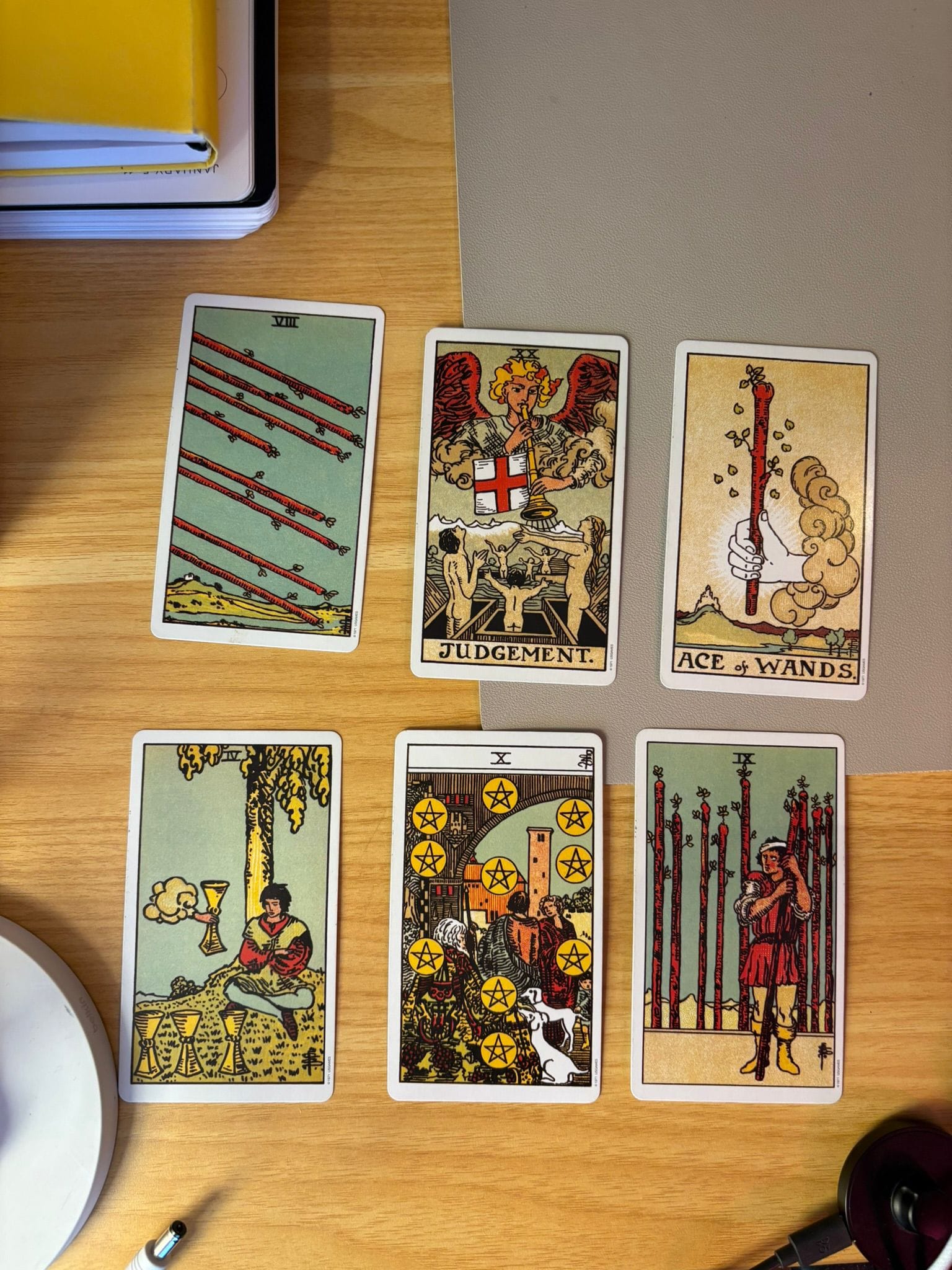
On my own transitional question, the card pulled in relation to my current role as a freelancer was the Eight of Wands. “What does this bring up for you?” Crystal asked. “They look a bit like daggers flying at me,” I responded after a minute. Crystal found this interesting. “This card is usually about momentum,” she explained. My knee-jerk response to that image and others helped me to articulate something I hadn’t quite said out loud before.
Many of the practitioners I spoke with stressed the importance of tailoring their witch-adjacent practices for different audiences. “In the States especially, there are some people who object, on a religious basis, to anything to do with Tarot, so we have to tread carefully,” says Naomi Clare, the founder of the experience design agency Storycraft Lab, which works with companies, including NASA, to better connect with their audiences.
“We developed our own cards, but we deliberately called them alchemy cards,” says Clare. “They’re tarot-esque in format, but they’re really a way for us to ask different questions—questions around interpretation, learning, and social preferences such as how do you prefer to engage in a conversation? Typically, she says, they’re used ahead of an event, “to gather more empathetic data,” and help shape what follows. As Clare sees it, a lot of work practices could benefit from being reframed in different, more mystical language, say, replacing algorithms with spells.
 Michele Shapiro
‘No one is above using spiritual tools’
Another new twist on tarot: The start-up founder ATW created Tech Bro Tarot, a set of Manga-style tarot cards that depict the current masters of the tech universe. There’s a Mark Zuckerberg card that represents “move fast” and one that pictures Apple founders Steve Jobs and Steve Wozniak that is meant to suggest “co-founder alignment.”
Originally, ATW created the deck for a party she threw that included some of her co-startup founders in San Francisco. “Tarot was something I enjoyed using to help navigate conflicting or complicated feelings I might have at work,” she says. “I figured that if I could translate some of these mysticism tools into the everyday language tech workers use, people might be more open minded about them.”
Indeed, the cards were a big hit, and her friends let her know that her readings had helped them with some business decisions.” But as the popularity of ATW’s cards and readings grew, so did the blowback, with people making fun of her. “It was interesting to see how polarizing it was,” she says.
Yet ATW believes that tarot-like practices are a valid way to help people navigate their emotions, a skill that is, she says, "unfortunately lacking in today’s world.”
“I also wanted to prove that no one is above using spiritual tools, and that if you can communicate the ritual or process in a person’s own language…they can benefit from it.”
I know I did. I quite liked exploring Crystal’s Art Nouveau-style cards and their evocative images. I didn’t have a clue what the cards should convey, but when, in the context of my side hustle, Crystal pulled the Ace of Wands, which I later learned meant “new beginnings,” something inside me said “That’s the one!”
So side hustle it is.
 Gabriella Griffith