I’m a Woman Who Lifts Heavy Weights. That Makes Me Feel Like I Can Do Anything.
Lifting weights has proven health benefits, particularly for women in middle age—but it can also be a way to tune out the chaos and doubt that life throws at you.

As a kid growing up in the Soviet Union, I was the epitome of unathletic: chubby, bespectacled, extremely slow at getting dressed (let alone running); afraid of heights, depths, lengths and widths. For me, any kind of sport was associated with humiliation, like being picked last for team sports in PE and my father taking me running on weekends so that he—and, although he never said so explicitly—so that I could lose weight.)
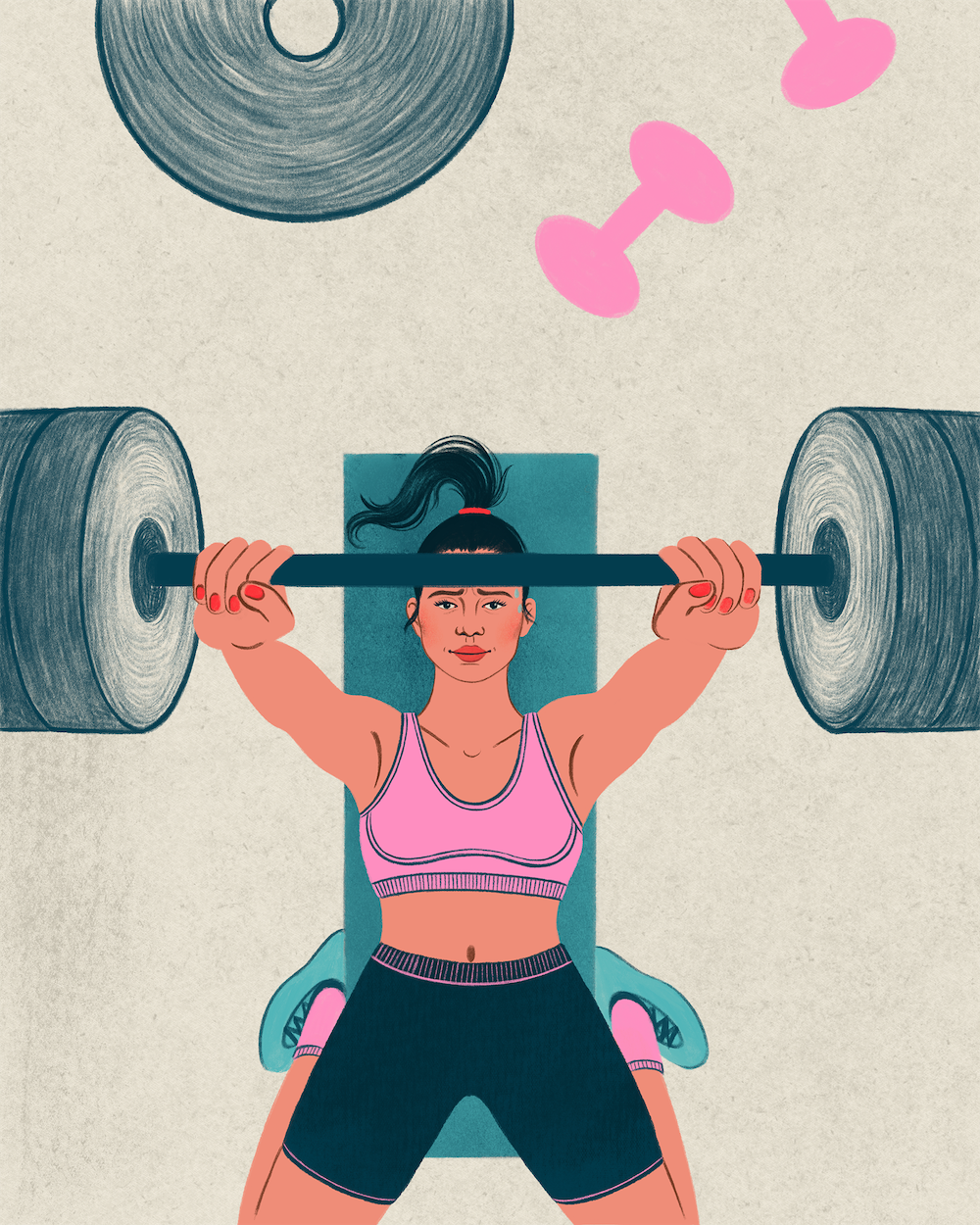
So how did I wind up with more than 110 pounds of metal suspended directly above my face, determined to bench press twice the weight of my youngest child. Could I really do it? And, maybe more importantly, why was I doing it?
It started in my twenties, when I was in graduate school at the University of Toronto in the early 2000s. That’s when a friend introduced me to Krista Scott-Dixon's blog about weightlifting for women. Krista urged her readers to ditch the tiny pink weights, skip the weight machines and head straight to the free weight section of the gym. She was the first fitness guru I knew of who gave women permission to focus on getting stronger instead of getting thinner. Inspired, I walked into the weight room at my university gym and discovered something unexpected: My body loved lifting heavy weights. And I was naturally good at it. Following the tips on Krista’s blog (which had a section comparing correct and incorrect form for each lift, appropriately titled “From Dork to Diva”) I learned the right way to perform the three basic powerlifting moves – squat, deadlift and bench press – as well as other lifts. I went to the gym with the same friend who introduced me to Krista, and we watched each other’s form and gradually built up enough muscle (and courage) to progress to heavier weights.
Back then, only about 17% of women in the US engaged in regular strength training, according to the CDC. Based on my own experience, my suspicion is that most of them did not do it in the free weights section. Twenty years ago, I was often the only woman biding my time for the squat rack among a crowd of sweaty, muscular guys. Today, 27% of women say they lift weights regularly, driven by the rise of CrossFit, the body positivity movement, and mounting evidence of the health benefits of strength training. And from what I can see, women aren't just lifting in greater numbers—they're lifting heavier.
My Only Constant
For me, though, strength training is not only about health—or even strength. Unlike everywhere else in life, in the weight room, the rules are clear and predictable: eat well, train right, focus. Show up consistently, get stronger.
To put it another way, lifting gives me something the rest of life doesn't—a sense of control. When you’re able to get your mind and body to cooperate and work together to make you stronger, it’s hard not to channel that strength into other areas of your life. If I can add 10 pounds to my deadlift, if I can pull my body over that bar for my very first unassisted pull up, if I keep showing up no matter what, then surely, I can face whatever life throws at me next.
I guess that’s why lifting weights has often been my only constant through twenty years of moves across continents, motherhood, divorce, caregiving, loss. I don’t always make it to the gym — sometimes life wins. But I always come back. Wherever I land, I find a place to lift.
Six years ago, after returning to Israel, I joined a CrossFit gym, then eventually followed my coach Gili when she opened her own functional training studio. For me, the place grew to feel like home.
 Emma Haslett
The Weight Above My Face
As I lay down on that bench, with the 100-pound bar above my face, I was vaguely aware that my fellow gym mates had stopped what they were doing to watch. I was being spotted by Michael, who is 70 years old and still lifts heavy things several times a week. When I grow up, I want to be like Michael. I overheard Gili say to him, “Keep her safe for me, ok?” which gave me a warm feeling that she had my back, that she cared. At one time, her words would have made me feel self-conscious – oh my god, she cares! Better not disappoint her. My mind almost went there…. to that place where you know people are watching and maybe have expectations. But I caught it in time and focused on the bar.
One thing they don’t tell you about power lifting is that it teaches you to focus. The night before that lift, I had cried myself to sleep with tears of despair and helplessness. My mom was still alive then, and her health was declining. Managing her care with my siblings took everything we had.
But at that moment, I couldn’t think about any of that.
I also pushed away the image of my daughter's bus aide, who, that very morning, had yelled at us because we were always too slow. “I’m going to leave without her next time!” she had threatened.
I even managed to tune out the tiny, insistent voice in my head that kept whispering that with my circumstances — a single mom caring for two kids and an aging parent — there would never be enough time and space for what I wanted: not for working out three times a week, not for all the creative projects piling up in my head.
I pushed everything away as I took the bar off the rack (Michael helped me), then bent my elbows and brought it all the way down to my chest. Then I pressed: one…(doable)… two… (steady)…
One thing that even powerlifting hasn’t changed is my self-image. I’ve been doing it for twenty years, but I still see myself as a slow, unathletic child, because aren’t we all stuck with the 8-year-old versions of ourselves? Still, that image no longer matters. Now I see myself as a slow, unathletic child who can squat 110% of her body weight and has the guts to lay under a bar hoping to bench press 110 pounds five times.
Three… (re-engage those lats)….
Four... remember to hold your breath and let it out only in the second half of the lift….
I couldn’t afford to be distracted, even by the supportive crowd around me. One slip in my focus and I'd risk dropping the weight on my face. I had to let their support buoy me, while also concentrating on nothing but the bar. I had to forget that other people even existed.
Fiiiive… was I doing it? I was doing it… I’d done it!!
Michael helped me replace the bar. Then I sat up grinning happily to the applause of the small crowd I'd forgotten was there, as Gili announced in her best sports commentator voice, “Tanyaaaa Mozias!!!” as if I’d just done a heavy lift at an elite competition and she was the official commentator.
At that moment, I felt as if I could do anything, anything at all. I could be there for my kids. I could bring all the creative ideas in my head to life. All I needed to do was to focus.
Perhaps that's the real power of powerlifting: It teaches you to focus in a way nothing else can. Not just on the bar in front of you, but on anything that matters. When you can tune out the chaos, the doubts, the watching world and zero in on what's directly in front of you, you discover that you're capable of far more than you ever imagined.
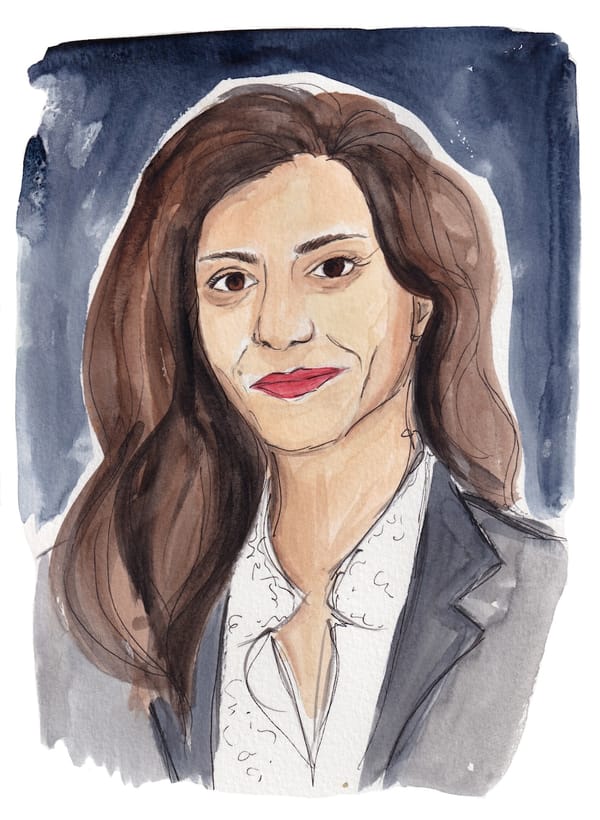
Tanya Mozias is a Russian-born, Israel-based essayist and linguist whose work has appeared in Oprah Daily, The Washington Post, The Boston Globe, and other outlets. She writes Friends with Words, a newsletter exploring language, identity, and culture through story.