

Artwork by Ilana Diamond.
The Persistent is available as a newsletter.
Sign up here to get it delivered to your inbox.
Regular readers of The Persistent know how much we love our forgotten feminists — indeed, we consider writing about them part of our mission.
Febb Burn, Jeannette Rankin, Margaret Fuller, Pauli Murray and Fanny Wilkinson — in no particular order — are just some whose lives have been obscured by the passage of time. All of them have gotten a second look in The Persistent.
But writing and reading about these remarkable individuals can sometimes feel a bit abstract. I wanted the tangibles: to walk the pavements they walked; to see buildings they worked; the streets they marched; I wanted to find their likeness in portraits, statues and monuments.
And that’s how I came up with the idea of doing a walking tour of Manhattan’s forgotten feminists. Why Manhattan? Easy. It’s where I live; though goodness knows there are many cities across America that would serve just as well as backdrop.
My tour took me from the southern tip of Manhattan all the way north, almost as close to the top of the island as I could get. That’s nearly 14 miles for anyone counting.
I went with my friend Darius — a journalist, lawyer and history buff. Or as far as I’m concerned, the ideal partner on a trek like this. We brought granola bars and water, phone chargers and bandaids. Most importantly, we made this video.
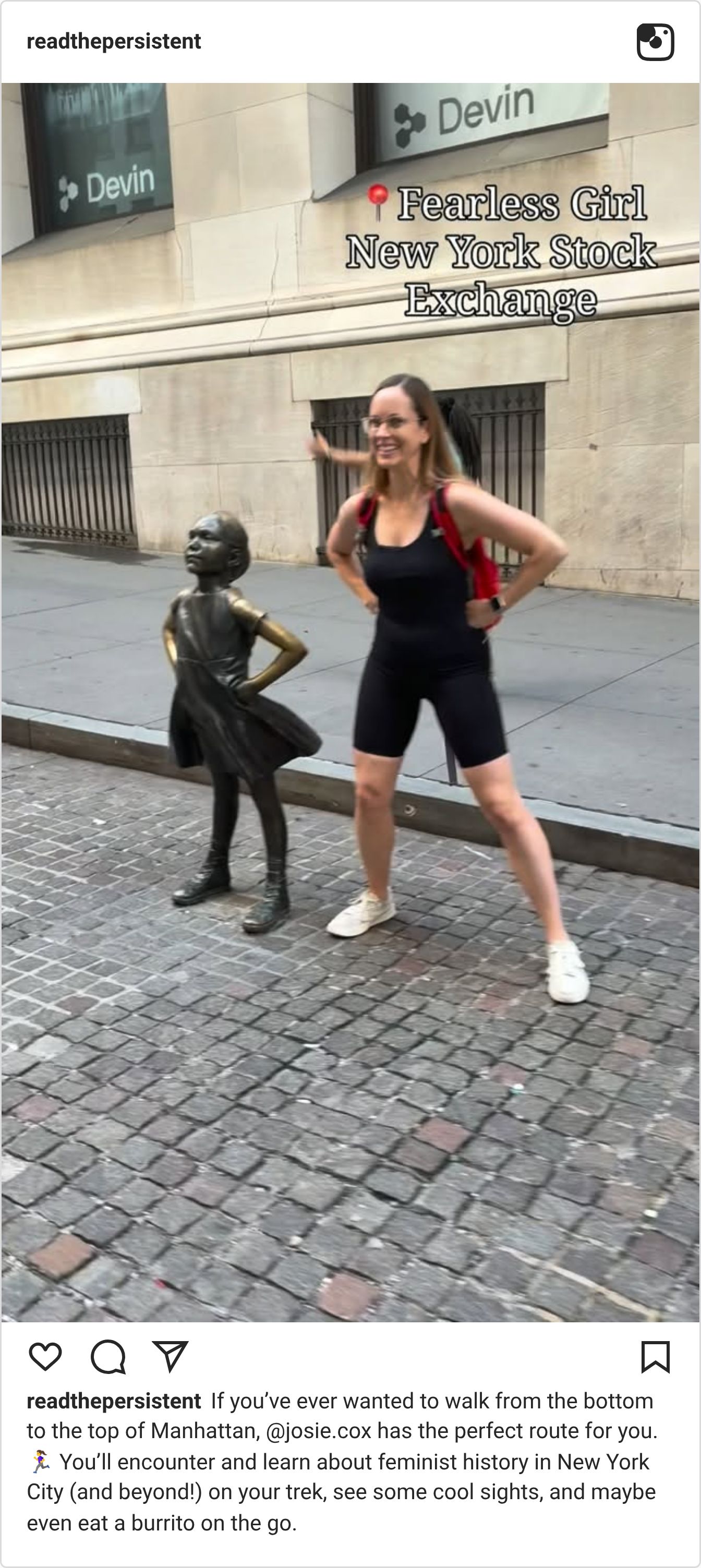
Fancy trying this jaunt yourself? I’ve posted instructions below for the sights that we stopped at. Not in the mood for a walk that long? Just pick and choose legs of the journey, or do your own research and create your own feminist history walk. (Definitely share your ideas with us!)
One important note: We could spend days walking the streets of Manhattan and still barely scratch the surface of the women who left their mark on the city, the country and the world. This route is not intended to be exhaustive; rather, it connects a selection of places and people that together make for a challenging, thought-provoking walk. There are countless other routes — and countless other forgotten feminists — waiting to be discovered. Once you start looking, you’ll find traces everywhere.
Whitehall Terminal, Staten Island Ferry
Start at the Whitehall Terminal of the Staten Island Ferry. It’s easy to find and accessible by public transport, making it a great meeting spot if you’re walking in a group. Take advantage of the public bathrooms and water fountains in the ferry terminal.
‘Fearless Girl’ at the New York Stock Exchange
From Whitehall Terminal, head north to Broad Street in the Financial District, where you’ll find Fearless Girl staring down the imposing facade of the New York Stock Exchange.
Created by the sculptor Kristen Visbal, the four-foot bronze statue first appeared in 2017 opposite Arturo Di Modica’s iconic Charging Bull. Fearless Girl was installed as part of a campaign to highlight the lack of women on corporate boards. In 2018, the statue was moved a few blocks to its current location, where her stance now seems to evoke something perhaps even more powerful: a small girl, hands planted firmly on her hips, staring down the exchange, one of the most powerful financial institutions in the world.

Artwork by Ilana Diamond.
Civic Fame at the David N. Dinkins Municipal Building
Keep walking north toward City Hall and look up — way up, yes, even higher. You’ll see an enormous gilded woman gracing the top of the Municipal Building. She stands about 20 feet tall, more than 500-feet above street level, and has presided over Lower Manhattan since 1913, a seemingly anonymous woman holding a shield and laurel branch and wearing a crown with five turrets representing New York’s five boroughs.
For years, the figure was said to be modeled on Audrey Munson, an artist’s model whose likeness appears all over New York and whom we’ll meet again later in this walk. (Read all about her here!) But recent scholarship suggests the sculptor Adolph A. Weinman may have used another model, Hettie Anderson, a Black woman who posed for some of the era’s most celebrated artists. Hettie or Audrey — it’s a rather perfect example of just how easily the identities of the real women behind New York’s cityscape are forgotten; how easily their identities fade, even if their image survives.
New York Infirmary for Indigent Women and Children, 58 Bleecker Street (formerly 64 Bleecker)
From the Municipal Building, continue north towards Bleecker Street. Near the far corner you’ll pass the site that was once the New York Infirmary for Indigent Women and Children, opened in 1857 by Elizabeth Blackwell, her sister Emily and fellow physician Marie Zakrzewska.
Elizabeth Blackwell was the first woman in the United States to earn a medical degree. At that time, though, for a woman, that qualification only meant so much. Hospitals were reluctant to employ female physicians. The sisters' solution was to simply create their own hospital, run by women, to treat women and children.
A decade later, Blackwell also established a medical college for women, helping create opportunities for generations of female doctors who followed her.
Triangle Shirtwaist Factory, 23–29 Washington Place
Continue west along Bleecker Street towards Washington Square. Just to the east you'll see the Brown Building, the former home of a “shirtwaist” — or women’s blouse — factory, now part of New York University.
On March 25, 1911, a fire tore through the Triangle Shirtwaist Factory on its upper floors, killing 146 workers, most of them young Jewish and Italian immigrant women.
Some workers were unable to escape because an exit door was locked; others jumped from the windows as crowds watched from below. Among the witnesses was Frances Perkins, who would go on to become Franklin D. Roosevelt’s Secretary of Labor — the first woman ever appointed to a U.S. Cabinet. (Read more about her here.)
The fire profoundly influenced Perkins's career and helped propel workplace safety and labor reform into the political mainstream. The permanent memorial to the women who lost their lives in the fire was completed in 2023. Look up at the metal ledge running around the circumference of the building as well as the steel ribbon circling near the bottom of the building and you’ll see the names and ages of the victims.
Josephine Shaw Lowell Memorial Fountain, Bryant Park
It’s a decent walk from Washington Square to Bryant Park so perhaps take a moment to rest your legs in Washington Square Park — you can grab a coffee, a snack, watch folks playing chess and busking, as I did, or simply enjoy a spot of people-watching.
Then walk north through the Washington Square Arch and all the way to Bryant Park. Entering the park from Sixth Avenue, head first to the Josephine Shaw Lowell Memorial Fountain, dedicated in 1912 to the pioneering social reformer who became the first woman appointed to the New York State Board of Charities.
Lowell campaigned on behalf of incarcerated people, working women and New Yorkers living in poverty and helped establish the New York Consumers' League, which campaigned for better conditions and wages for female workers. Lowell was the first woman to be honored with a major public monument in New York City.
Gertrude Stein, Bryant Park
Walk east through the park toward Fifth Avenue. Almost directly behind the huge Stephen A. Schwarzman Building of the New York Public Library, you’ll see a bronze bust of Gertrude Stein, the American writer whose experimental prose helped make her one of literary modernism's most distinctive voices.
Stein moved to Paris in 1903 with her brother Leo and later, her partner Alice B. Toklas. Together, they assembled a massive collection of modern art, turning Stein’s home into a salon frequented by Picasso, Matisse, Hemingway and other f avant-garde figures of the time. The bust in Bryant Park is a cast of Jo Davidson's 1923 portrait of Stein.

Artwork by Ilana Diamond.
Pomona, Pulitzer Fountain, Grand Army Plaza
Make use of the public restrooms in the Public Library if you need, then continue north up Fifth Avenue and through the heart of hectic Midtown — weaving between Rockefeller Center and St. Patrick’s Cathedral — until you get to Grand Army Plaza, opposite The Plaza.
When you arrive, look for the nude bronze goddess standing atop Pulitzer Fountain. Her name is Pomona, and she is the Roman goddess of abundance. Her figure is generally thought to be modeled on Audrey Munson.
Munson was one of America's most famous artists’ models in the early 20th century, posing for a huge number of sculptures and earning nicknames including “Miss Manhattan.” Her body became extraordinarily visible across the American cityscape while the woman herself largely vanished from popular culture — a theme worth keeping in mind as you continue north.
Women's Rights Pioneers Monument in Central Park
Cross the road and enter Central Park, taking a moment to appreciate the changing cityscape. As you skirt around the Central Park Zoo, listen closely for the barks of the sea lions. What a nice change from the honks and sirens of Midtown traffic.
Make your way to Literary Walk (nod to the imposing statue of William Shakespeare, whose works — who knows? — might have been written by a woman) and then continue to Meredith Bergmann's glorious Women's Rights Pioneers Monument, which depicts Sojourner Truth, Susan B. Anthony and Elizabeth Cady Stanton in conversation.
Its unveiling in 2020 marked the first time in the park’s 167-year history that real, historical women were immortalized in a monument. There were plenty of fictional women — Alice in Wonderland and Shakespeare's Juliet, for example — but actual women were absent. The unveiling of Truth, Anthony and Stanton finally broke what equality campaigners called Central Park's “bronze ceiling.”
Eleanor Roosevelt Monument, Riverside Park at West 72nd Street
Just before the Bethesda Fountain, cross the park toward Strawberry Fields — another great place for a short break and a musical interlude — then peel out, heading west on 72nd Street, past the historical Dakota building and all the way to Riverside Park, where you’ll be rewarded with Penelope Jencks' monument to Eleanor Roosevelt, dedicated in 1996.
Between 1933 and 1945, Roosevelt redefined what it meant and means to be a First Lady, using her position to champion women, workers and civil rights. But her public career didn't end with her husband's presidency: After Franklin Roosevelt's death, she became a U.S. delegate to the newly created United Nations and chaired the commission that drafted the Universal Declaration of Human Rights.
Enjoy the serenity that Jencks’ monument conveys — regardless of the season, you’ll see birds perched on her head and, honestly, I don’t think Roosevelt would mind.
Joan of Arc Memorial, Riverside Drive at West 93rd Street
Now enjoy a stroll north along Riverside Drive’s comparative calm. This is where locals go to rollerblade, jog and stroll and you’ll see the Hudson River on your left. Keep walking until you spot the huge statue of Joan of Arc on horseback, sword raised toward the sky.
The monument, unveiled in 1915, was created by a female sculptor, Anna Hyatt Huntington. That, in and of itself, is worth dwelling on: A woman sculptor commemorating a real female historical figure at a time when women across the country still didn’t even have the guaranteed right to vote.
Joan of Arc was herself still a teenager when she led French forces during the Hundred Years' War; captured by the English and their allies, she was tried for heresy and burned at the stake in 1431, aged about 19.
Straus Memorial, Broadway and West 106th Street
When you hit Riverside Drive and West 106th Street, turn right and walk until you get to Broadway, pausing at another welcome pocket of green: Straus Park. The memorial here commemorates Ida and Isidor Straus, the husband-and-wife philanthropists and Macy's co-owners who died together aboard the Titanic in 1912.
Nearby you’ll spot a reclining female figure entitled Memory. Look familiar? Look carefully and you’ll recognize the distinct features of Audrey Munson who, in this case, modeled for sculptor Augustus Lukeman.

Artwork by Ilana Diamond.
Ida B. Wells, Pulitzer Hall, Columbia Journalism School
Continue north on Broadway until you get to 116th Street and the entrance to Columbia University, on your right. (To your left is the Barnard College campus; more on that below.) Columbia’s campus is almost never open to the public, but if it were, you’d head inside Pulitzer Hall, as I did. In the lobby, you’ll find a bronze bust of Ida B. Wells by the artist (and former journalist) Dana King, unveiled in 2024.
Born into slavery in Mississippi in 1862, Wells became one of America's most fearless investigative journalists. Her reporting systematically exposed the lies used to justify lynching, work she continued despite threats to her life and the destruction of her newspaper office. She was also a civil-rights and suffrage activist who refused to ignore racism within the women's movement itself.
Pulitzer Hall isn't always accessible to visitors, but even if you can’t get inside, the building itself is still a wonderful place to pause and remember one of American journalism's great pioneers.
Barnard College, Broadway at West 116th Street
Leave Columbia’s campus and cross the street to Barnard College, founded in 1889 after Columbia repeatedly declined to admit women.
The college was named after Frederick A. P. Barnard, a Columbia president who had unsuccessfully advocated for women's admission, but its creation owed much to the campaigning of Annie Nathan Meyer, a young Jewish writer and activist determined that women should have access to the same rigorous education as men. More than 135 years later, Barnard remains a women's college affiliated with Columbia University.
Margaret Corbin, Fort Tryon Park
Now comes the longest stretch of the walk, so give your legs a quick rest, then keep heading north toward Fort Tryon Park, perhaps stopping for a sweet break at the Chipped Cup in Sugar Hill in Harlem.
Eventually, you’ll get to Margaret Corbin Circle and Margaret Corbin Drive — the traffic circle at the entrance to Fort Tryon Park. In 1776, during the Battle of Fort Washington, Margaret Corbin accompanied her husband John, who was serving with an artillery company defending Manhattan from British and Hessian forces. When John was killed, Corbin took his place at the cannon and continued firing until she was severely wounded.
She survived and later received financial support from the Continental Congress for her wartime injuries. She is believed to have been the first American woman to receive a military pension.
Abby's Lawn, Fort Tryon Park
Take your time in Fort Tryon Park. After the intensity of Midtown, the hum of the Upper West Side and the vibrancy of Washington Heights, this wooded expanse can feel almost otherworldly in its tranquility. Be sure to breathe it in.
Now make your way down to Abby's Lawn, one of the most beautiful viewpoints on the entire route. The origin of the name of the lawn is surprisingly difficult to pin down, though it’s thought to commemorate Abby Aldrich Rockefeller, an art collector and philanthropist who was instrumental in the creation of New York's Museum of Modern Art — the MoMA.
Rockefeller was far more than just the wife of oil magnate John D. Rockefeller Jr., America’s first billionaire. Abby was an adventurous collector of modern and folk art at a time when neither enjoyed establishment approval. In 1929, she parlayed those passions into the founding of the Museum of Modern Art — MOMA — along with Lillie P. Bliss and Mary Quinn Sullivan.
Take a moment to rest on the lawn, look across the Hudson — and recognize just how far we’ve come, both metaphorically, historically and perhaps literally too. If you started the walk at the Staten Island Ferry terminal, you'll have covered just about 14 miles at this point.
Fourteen miles, more than a hundred years, and a fight that continues to this day, for women to be seen and heard.
—
Josie Cox is a journalist, author, broadcaster and public speaker. Her book, “WOMEN MONEY POWER: The Rise and Fall of Economic Equality,” was released in 2024. 💛 Ilana Diamond is an illustrator based in the San Francisco Bay Area. After years in the photo and art departments of magazines and agencies including New York Magazine, Wired, San Francisco Magazine, and IDEO, she now illustrates full-time, with illustrations appearing in Gazetteer and Ramona Magazine. See more of her work at @ilanadiamond_illustration.
Read more.


Note: As a Bookshop.org affiliate, The Persistent will earn a small commission if you buy a book through a link on this page. Thanks for supporting independent bookstores! 📚


