In Paris, I’m an American First, a Black Woman Second
At first, Paris appeared to be a city where race didn’t matter. But things weren’t all they seemed.

I moved to Paris from Brooklyn on a sweltering August day in 2025, dragging three suitcases, a carry-on, and a gnawing sense that I was running out of time to change my life. I told everyone I was moving for grad school—which was true. I’d been accepted into an MFA program in creative writing, something I’d considered doing for years but kept postponing for a series of what felt like “dream jobs” at various media companies. Or maybe I just dreaded the paperwork that it takes to move abroad—the logistics of visas and apartment searches. But in the end, what pulled me was something simpler: I needed to reset, even if temporarily.
In Brooklyn, I’d built a version of adulthood that looked right but felt wrong. My job was respectable and vaguely impressive on LinkedIn, the kind that made people nod approvingly at dinner parties. But it wasn’t serving me. My days blurred into Microsoft Teams messages, bodega salads, and the low hum of dissatisfaction that to me, signaled that I was living a life that technically worked but didn’t quite fit. Then I turned 30, an age that made everything feel suddenly urgent—as if the window for my reinvention was beginning to close. And underneath it all was an angst and fatigue born of watching my country unravel in real time.
In Brooklyn, I’d built a version of adulthood that looked right but felt wrong.
Every week brought a new headline that made America feel a little less livable: rising rents, book bans, another court ruling clawing back rights that once seemed untouchable. It started to feel as if the walls were closing in, not just on me but on the idea of possibility itself. Paris beckoned as a kind of reset button—a place where I hoped to step outside the performance of who I’d been and imagine a different and more authentic way to be.
The city wasn’t a random choice, though the allure of “Emily in Paris” and the romance of writing in cafes didn’t hurt. I chose Paris because it was one of the few cities outside the United States where I already had a community. Friends had moved there—artists, writers, people tired of the grind (and divisive politics) of American life, who were longing for slowness, work-life balance and a healthier lifestyle.
I also knew Paris had a large Black population—people from the Caribbean, West Africa, everywhere—and I was drawn to that plurality. It was comforting to know that other Black Americans had done this before me: Josephine Baker, James Baldwin, Ta-Nehisi Coates. To be sure, I had the privilege and resources to be able to get out of America when I chose, but the lineage was there: a reminder that I wasn’t doing something new, but joining a tradition of escaping systemic racism in the U.S.
The lineage was there: a reminder that I wasn’t doing something new, but joining a tradition of escaping systemic racism in the U.S.
I’d always read that Paris offered Black Americans a freedom they couldn’t find at home—freedom from having to be vigilant, from the quiet and not-so-quiet ways the United States reminds you of your place in the hierarchy. But I never fully believed it. It sounded romanticized, maybe naive—a myth constructed to survive the disappointment of being Black in America. And certainly, what I’d read in the news suggested that like the U.S., France has a complex, often ugly history when it comes to accepting other races and religions. As in other European countries, France has also moved toward the right in recent years–and racism has been on the rise. And what I found when I got there was complicated–just not exactly in the way I expected.
Brusque, direct, but not suspicious
When I arrived, it was as if a switch had been flipped: The difference in how I was perceived in Paris versus the United States was evident in the smallest, most mundane exchanges—the kind that shouldn’t matter, but always do. In America, I’m used to reading a room before I enter it. A lifetime of social conditioning has taught me how to shrink, soften any edges, or overperform politeness depending on where I am and who I’m with. When I walk into an expensive restaurant in New York, I brace myself for the possibility—no, the likelihood—of being seated near the kitchen or being greeted with indifference. When the waiter finally approaches, there are often unasked questions lingering in the air: Am I a good tipper? Am I actually going to order an entree? Should I even be here?
Am I a good tipper? Am I actually going to order an entree? Should I even be here?
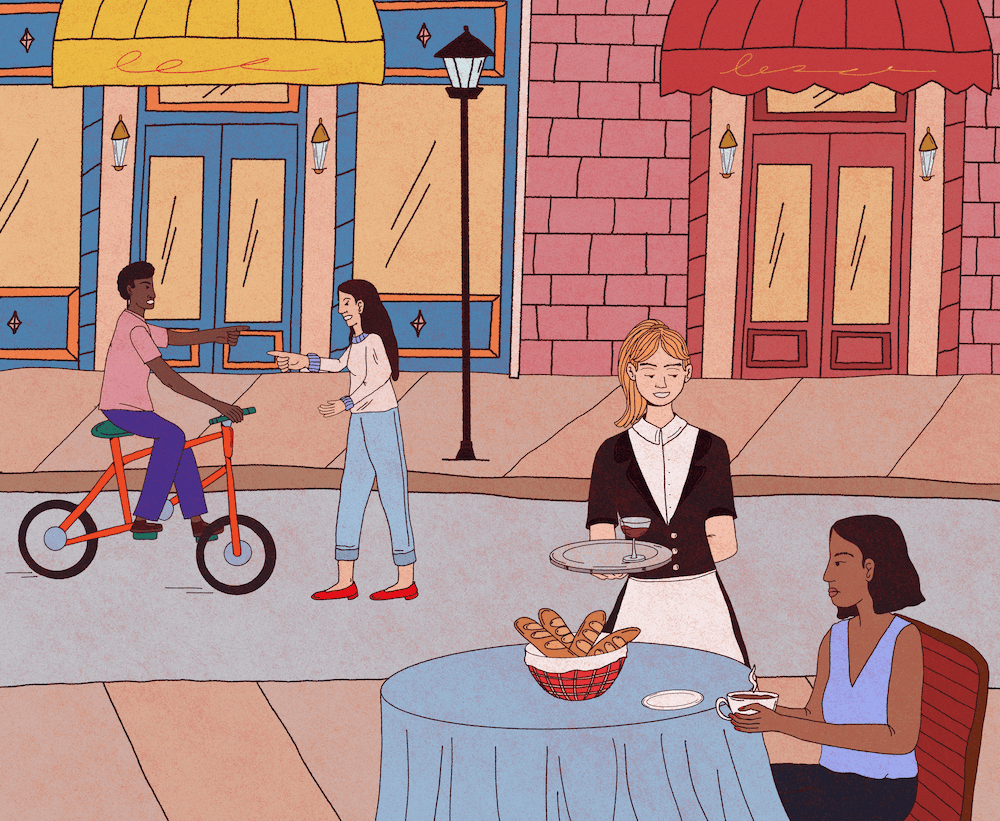
In Paris, for me, that tension disappeared. In this city, I’m treated the way every customer expects to be treated—sometimes brusquely, always directly, but never with suspicion. I’ve been offered tables near windows, poured a second glass of wine without being asked, and greeted with “Bonsoir, madame,” civility being the default rather than performative. The first few times, it startled me. I wasn’t used to being met without preconceptions.
 Amita Joshi-Welton
Sidestepping the constant surveillance
Shopping, however, is where the difference feels most visceral. In the United States, stepping into a high-end boutique means preparing for scrutiny—specifically, the subtle choreography of surveillance. The store associate’s eyes flick up and down, scanning your outfit, your bag, your shoes, calculating your purchasing power before deciding whether to offer help or hover suspiciously in the background. It’s an unspoken rite of passage for Black people in America: to be followed, doubted, presumed out of place.
In Paris, I didn’t feel that weight. In stores, I was left to browse freely, to touch, to try, to wander without being shadowed. The assumption isn’t that I can’t afford to shop in a particular place— it’s that I wouldn’t be there if I couldn’t. There’s a quiet dignity in that presumption of belonging, a sense of neutrality that, for me, feels new and radical.
The same thing happens in taxis, at cafes, at makeup counters—all the situations and places where, in America, my Blackness precedes my presence. Here, I’m not flattened into the same old stereotype. Instead, I’m seen as a woman first, then as an American, and only then as Black. Of course, my experience may not be reflective of everyone else’s, but from where I sit, it’s a subtle but powerful reordering of my identity, one that alters how I move through the world—more freely and relaxed.
But that feeling exists within a paradox. The French Constitution insists that every citizen is equal under the tricolor flag. Yet to live in a Black body here is to also experience how that apparent so-called neutrality can also be a disguise, one that sometimes masks erasure or outright hostility.
 Paula Derrow
The prejudices make the paradox
A month into my move, this contradiction came to light on the street one afternoon, when I witnessed an altercation between a Black African delivery person on a bicycle and a group of white French women who had stepped into the street against the red light. The cyclist swerved but clipped one of them anyway. The women began shouting, their French sharp and venomous. One struck the man with her bag. Another spat a slur. The eldest punched him full on in the face.
For a moment, I was back in America, except no one was whipping out their phones to take a video. But my instinct wasn’t to record; it was to intervene. I yelled at them to stop, to leave the man alone, that they were acting barbarically—in English, in my American accent—and the atmosphere shifted instantly. The women paused, and instead of turning on me, one appealed to me: “You saw, yes? He was in the wrong.” Instead of seeing me as a Black person like the bike messenger, my accent transformed me into a potential ally instead of a potential threat.
As I watched them walk away, it struck me that my nationality rendered me “acceptable.” Rather than being an “other” in Paris, my Blackness became palatable, existing outside the French colonial imagination. After all, America was never a French colony. The same city that vilified African immigrants had made room for me—not because it was a more evolved place than my home country, but because I represented a different kind of Blackness, one that carried the cultural currency of American cool.
 Tanya Mozias
Power of the pocketbook
Of course, in Europe, “American” is also shorthand for spending power. To be American—even an unemployed grad student version of American—comes with an aura of wealth and access. Our salaries are rumored to be higher, and so are our expenses. There’s this idea that if you live in America—if you can afford America—then you’re well-off. That soft privilege ripples outward. In Paris, it’s what separated me from the Senegalese and Algerian women selling perfume samples in the metro, even though our skin tones matched. My passport signaled leisure, not labor. My Americanness aligned me with power because it implied that I could pay.
There’s this idea that if you live in America—if you can afford America—then you’re well-off.
But that didn’t mean I was safe from the less noticeable prejudices, or, at least, hearing about them. A few weeks after the bike incident, over lunch, a Parisian acquaintance launched into a casual rant: He believed immigrants were “causing problems” in Paris, mentioning recent traffic altercations with Arab men. He emphasized this detail, the way people do when they’re trying to prove a pattern. “I never have issues with anyone else,” he said. Then came the confession that didn’t feel like a confession at all: He didn’t want his 5-year-old son attending a school where children were allowed to wear hijabs. “It just isn’t French,” he said. It wasn’t his words that startled me, but his ease in saying them—to me, a Black woman. He assumed I’d agree.
What he couldn’t see was the irony of our conversation, that the stereotypes he projected onto Arab men were nearly identical to the ones projected onto Black men and Black women in the United States. And yet, he imagined me to be a confidante, someone who would understand his frustration. He seemed to believe that my proximity to whiteness, through education, accent, class, or nationality, placed me on his side of the debate. It didn’t. Shortly after this lunch date, I cut ties with him.
This man, and the women from the bike incident, assumed that as an American, I was aligned with those in power–Western before I was Black, more “with them” than “other.” It reminded me how whiteness isn’t only racial —it’s geopolitical. In France, I was folded into a category that I would never be granted within the U.S.
That sort of privilege—for me and other Black Americans—is one that exists only abroad. As Black Americans, when we leave the United States, carry a paradox: We are both fugitives and ambassadors. Abroad, we shed the heaviness of being perpetually targeted and inherit the softer identity of the cosmopolitan traveler. Our Americanness becomes our protection.
As I’ve experienced, that doesn’t mean racism disappears. Anti-Blackness is global; it just changes accents and targets. In France, the burden falls on North and West Africans. But my time here is a reprieve—one that only exists because someone else is absorbing the hatred I’ve temporarily escaped.