It’s My Face, and I’ll Frown If I Want To
Tired of random strangers of the male variety telling you to smile? So are we. Here’s why it happens, and what to do about it.

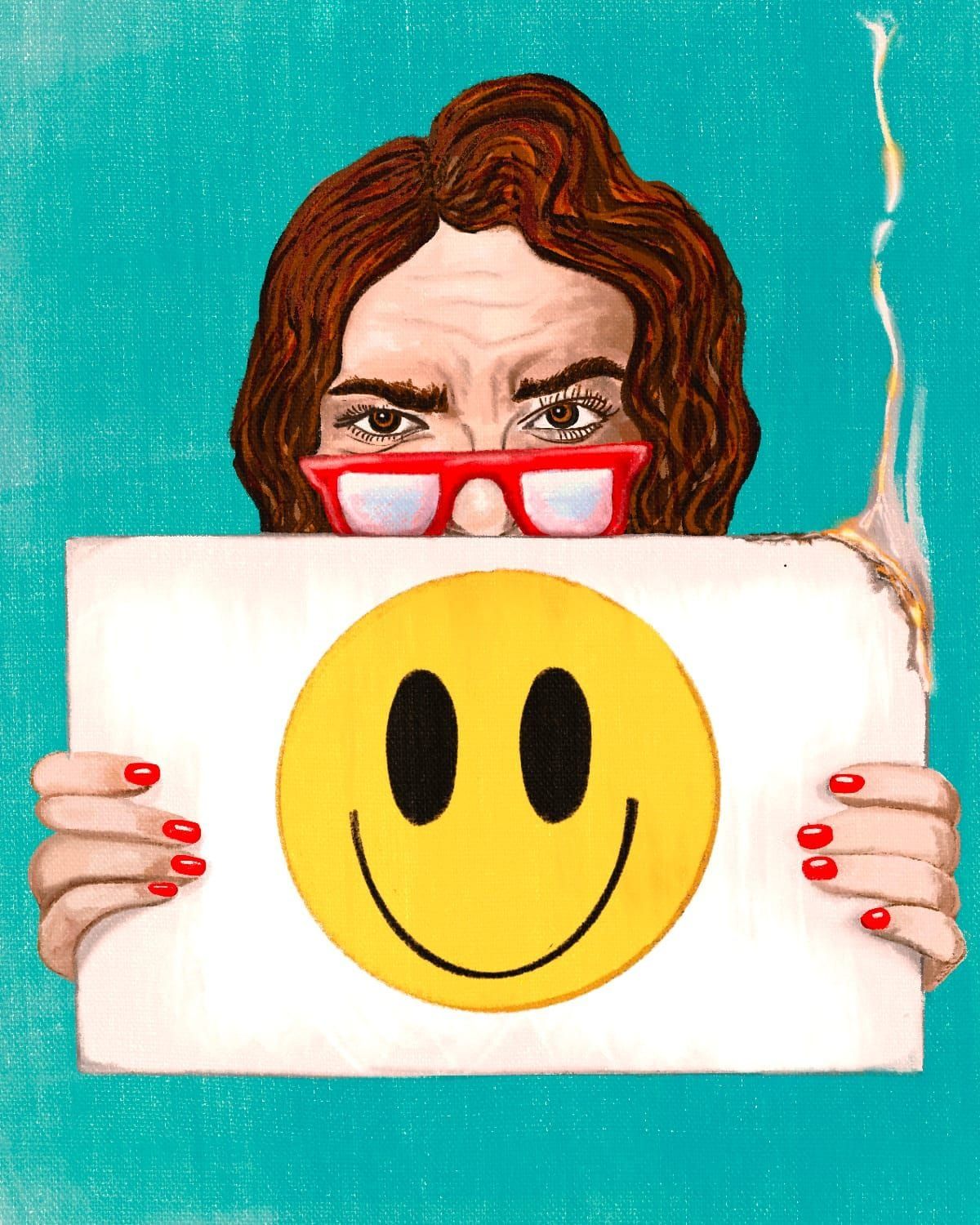
For as long as I can remember, people (mostly men) have told me to smile. I’ve heard it from colleagues, strangers on the street, even from my parents’ friends when I was a teenager. I assume these folks think smiling would make me look prettier, happier or more approachable. Maybe they mean well, but whenever I get the various versions of “Smile, honey!” or “You dropped something — your smile,” I feel bullied.
It’s no wonder. I’m essentially being asked to hide my true emotions. “Telling someone to smile is a way of invalidating their experience, as if they need to mask what they’re dealing with because the world doesn’t want to see it from them,” says Michele Patterson Ford, Ph.D. a chair of the psychology department at Dickinson College. For the person on the receiving end of these directives, smiling on command can feel performative (at best) and demeaning (at worst). When I do it, I feel dishonest — as if I’m betraying myself, slapping on a happy face when I don’t feel like it, simply to satisfy someone else.
Infuriating and destabilizing
Being on the receiving end of such requests can feel controlling or manipulative – “It pressures you into emotional labor — it’s exhausting to feel like you have to put on a smile when you don’t feel like it,” says Robin Stern, Ph.D., cofounder of the Yale Center for Emotional Intelligence and author of “The Gaslight Effect.”
And yet, the smile requests keep coming. It happens all the time, to all of us. Who can forget Donald Trump, in February of this year, chastising CNN’s Kaitlan Collins for not smiling: “I’ve known you for ten years and I don’t think I’ve ever seen you smile!” is what he said when she asked him about the Epstein files. Hillary Clinton was regularly subjected to criticism for not smiling during her 2016 presidential campaign. And similar comments have been lobbed at professional athletes and celebrities who happen to be women, including Serena Williams, who was famously asked by a reporter why she wasn’t smiling (“I don’t want to be here right now,” was her terse reply); and actress Kristen Stewart, whose unsmiling mien is featured in one article under the headline, ‘Kristen Stewart Denies Having Resting Bitch Face.’
So what lies beneath this bizarre habit of men telling women to smile more. Is it a sense of entitlement on the part of men, based on the idea that women should serve as eye candy for them? An expectation that women should always look like cheerful, attractive people to please others? Or is something else going on?
 Josie Cox
‘Benevolent sexism’
Ford, the professor at Dickinson College, likens the unwanted comments to flinging a microaggression. And indeed, the practice is so pervasive that psychology experts have a name for it (along with other seemingly kind compliments and behaviors that really aren’t): “benevolent sexism.” It’s a misnomer if there ever was one.
Telling a woman to smile is “a way of objectifying [them], as if to say they’re not as pretty as they should be or they’re not acting the way they’re supposed to be acting,” Ford says. But far from being benign, these kinds of comments can be harmful, particularly at work. In a report in the March 2022 issue of Frontiers in Psychology, researchers found that microaggressions toward women (including microinsults and microinvalidations, often pertaining to women’s appearance), are still highly prevalent in many industries, and have a measurable impact on factors such as women’s job satisfaction and self esteem.
“[These kinds of remarks have] become normalized for women — so much so that we’re almost desensitized to them,” says Ford. But we have to acknowledge that these microaggressions are a form of badgering.
A power grab by any other name
Just like other forms of harassment, when it comes to telling a woman to smile, “power has everything to do with it,” says Marianne LaFrance, Ph.D., a professor of psychology emerita at Yale University and the author of “Why Smile? The Psychology Behind Facial Expressions.”
“Typically, in cultures where men have the power and women don’t, misogyny tends to be rampant, and this kind of behavior stems from that,” she says. Telling someone to smile, she adds, can also be an all-purpose way to get attention from women without creating a scene, since it’s not as overtly obnoxious as cat-calling or explicitly commenting on a woman’s body.
Then again, maybe it’s pretty close. “When a man tells a woman to smile, there’s an assumption that he won’t be challenged or criticized for it,” says LaFrance.
The fact that many women are brought up to be people-pleasers can also make us easier targets for this kind of attention. “We’re socialized to smooth things over and accommodate others,” says Yale’s Robin Stern. “At times, women may even interpret these remarks as flattery,” Stern acknowledges.
But while these patronizing ‘smile, honey’ tropes may seem innocuous, they reinforce women’s subordinate status, imposing a man’s wants and needs on her, regardless of what she is feeling, according to Stern.
Resume what comes naturally
What’s the best way to respond to this frequent request? With strangers, my knee-jerk reaction has been to purse my lips while thinking: Why should I smile if I don’t feel like it? Other times, I’ll flash a quick, phony smile to put an end to the exchange. Neither one feels very satisfying. Then there’s the fact that reacting at all can backfire. “You may end up eliciting another comment and further engagement,” notes LaFrance, whose advice is to ignore the remark and keep moving — “It’s the least costly response,” she says.
If you choose to engage – and no one is saying that you have to – Stern recommends using humor, and likes the phrase, “It’s not a good day for smiling.” Then again, there’s always resting bitch face to fall back on… no work or zippy responses required.
But if smile requests happen frequently with someone you know or work with, Stern recommends setting a clear boundary, by letting them know how their comment landed (Hint: not well.)
Whatever approach you choose, it's important to acknowledge and validate your own feelings. “We don’t have to show up for others the way they want us to,” says Ford.
As for me, more often than not, my default facial expression is neutral, but whatever I happen to be feeling, I’m going to aim to stay true to myself as I move through the world. I don’t owe anyone a smile just because they ask for one. Instead, I’ll smile when I feel like it and not when I don’t. It’s my face and I’ll frown if I want to.
 Kathleen Davis