Why Crafting is, and Always Has Been, a Rebellious Act
From suffragists’ embroidered banners calling for votes for women to the potent symbolism of pink pussy hats, stitchwork has always been a distinctly feminist way of rebelling.

February is usually a month I spend hunkered down. But this year, a few months ago, in the dead of a frigid Northeast winter, I was drawn out of my warm house by a blinding rage tempered with the smallest glimmer of hope. The rage was for the Trump administration’s abhorrent treatment of immigrants, for ICE’s incursions into Minnesota, and for my New Jersey neighbors' detentions in Newark’s Delaney Hall.
And the hope?
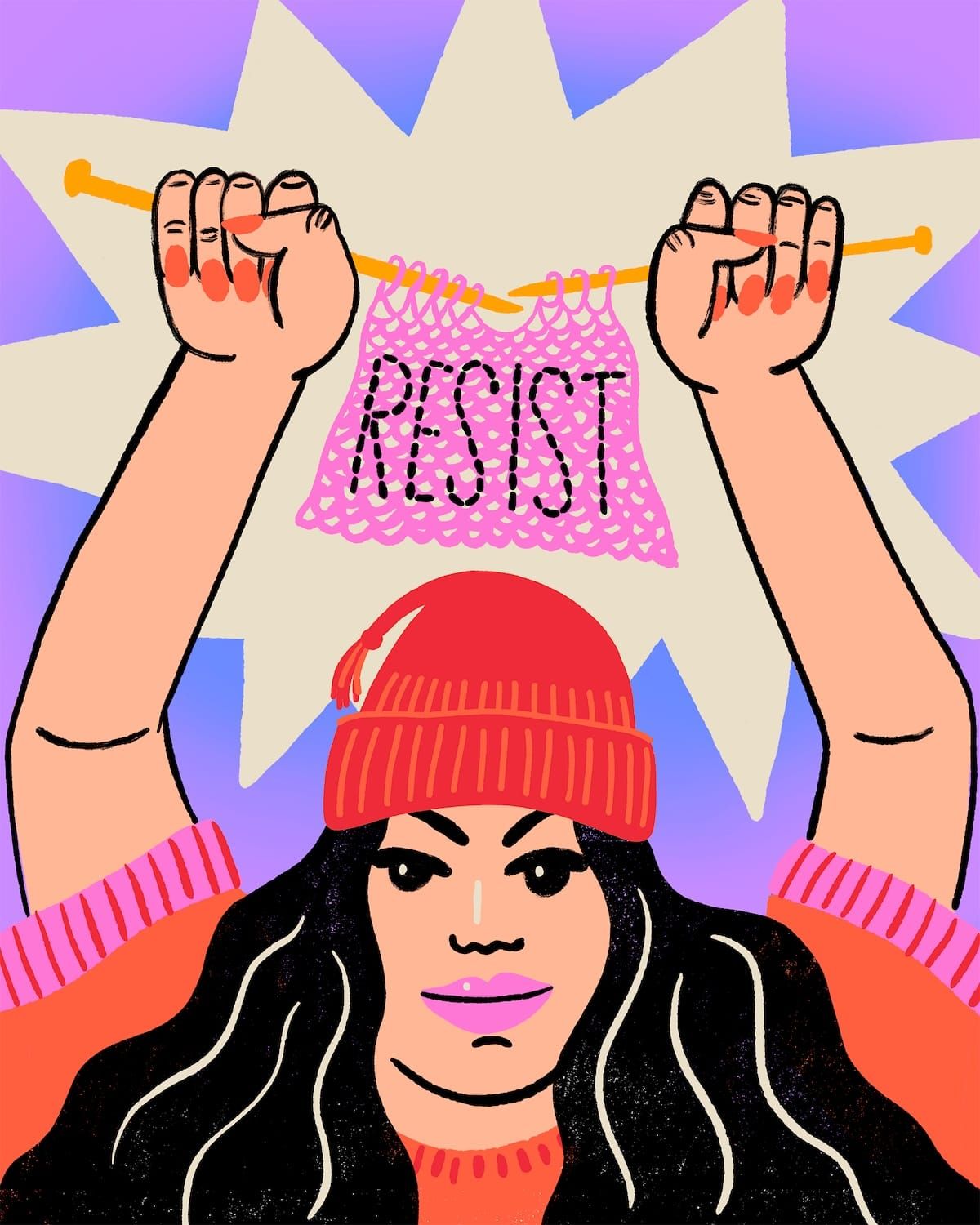
That came from a group of New Jersey knitters who refused to sit idly by. Instead, they rallied the community for an event dubbed “Melt the ICE Night.” These craftivists — that’s craft + activist, which stands for resistance through making — joined knitters all over the world, wielding their needles in protest against ICE.
From 7 million women in pink pussy hats at the 2017 Women’s March to yarn bombing (think: graffiti with wool) in countries including Denmark, Mexico and the U.K., craftivism seems to be all the rage right now. But it’s also part of a centuries-long tradition of makers who fight oppression with craft.
Like many great ideas, the spark for Melt the ICE Night was nurtured in a knitting circle comprised of my neighors. “What’s powerful about crafting is that it’s done in an analog group,” explains the aptly named Emily Kraft, a knitting teacher, craftivist, and mother of twins in New Jersey. When you knit together, she told me, “You get the inside scoop on the town and what’s going on politically.”
The group felt simultaneous horror and helplessness over ICE’s incursions into Minnesota.
“It felt disingenuous to wake up in the morning and get the kids to school and act as if everything was fine,” says Kraft. But then someone in the group mentioned reading about the Melt the ICE hat, which had inspired protest knitting circles stretching from Vermont to Oregon. The pattern for the tassled red knit cap could be downloaded for $5, with all the proceeds going to immigrant aid organizations in Minnesota. The hat had been conceived of by an employee of Needle and Skein, a yarn shop in Minneapolis. The design was inspired by a hat from the 1940s worn by Norwegians to protest the country’s Nazi occupation.
“Within 24 hours of posting the pattern, we had thousands of sales,” says Gilah Mashaal, the owner of Needle and Skein. “We thought we’d raise $500; we surpassed $5,000 almost immediately.”
Meanwhile, back in New Jersey, the women in the knitting circle got organized. “For us, this [event] was a way to reclaim some power in a powerless situation,” explains Kraft.
The circle’s “Melt the ICE Night” took place inside a cavernous former train station. Rows of women perched at long tables furiously knit red hats topped with little braided tassels, but it was impossible to hear the click of needles amidst all the activity: A lawyer stood before a microphone offering language to use with legislators when advocating for immigrants; children crowded a table strewn with blank postcards, stickers and markers. A laminated sign the color of a kumquat read: Te estamos pensando. La esperanza nunca se pierde! La unión hace la fuerza — “We are thinking of you. Unity makes us strong. Hope is never lost!”
There were at least 100 people gathered that night and the momentum has shown no signs of letting up. Sales of the Needle and Skein pattern have now topped $900,000.
‘Tedious, domestic diversions’
Needlework has been around at least since the Stone Age, as evidenced by needles made from tooth roots found in caves in South Africa.
Still, it has often been dismissed by the Western world, and by men in particular, as a mere hobby, a tedious domestic diversion . Think “women’s work” a la Jane Austen.
Freud, for one, linked constant needlework to women’s propensity for “hysteria.”
People think of it as “mindless, decorative and delicate… good to look at … but devoid of significant content,” according to Rozsika Parker, who wrote often about art history and psychoanalysis and was the author of the irresistibly-named “The Subversive Stitch: Embroidery and the Making of the Feminine.” But as Parker concludes at the end of her much-cited book, “women … have managed to make meanings of their own in the very medium intended to inculcate self-effacement."
In other words, do not underestimate the power of the needle.
Of course, the reality is that needlework, knitting and weaving has always served an urgent purpose. Aside from clothing to keep humans warm, consider the women who sewed parachutes for soldiers during WWII or the Navajo rug weavers in New Mexico who were hired to create the circuits that would power the first moon landing. Apparently, reality and perception don’t always align.
Then again, what more perfect means for mounting resistance than with an activity that so many are quick to dismiss?
Indeed, there is evidence of women weaponizing their crafts for change throughout all of history, from the suffragists embroidering protest banners to women knitting code into hats and scarves and covertly passing them to Allied Intelligence during World War II.
The power of crafting showed up again in late ‘70s Argentina, when, during the oppressive military regime, a group of women who became known as the Madres de Plaza de Mayo embroidered the names of their disappeared children on cloth diapers, then wore them as headscarves, walking arm-in-arm in front of the Presidential Palace and ultimately exposing and delegitimizing the dictatorship.
And let’s not forget Madame Defarge, who, in Charles Dickens’ ‘A Tale of Two Cities,’ knit into a scarf the names of those condemned to death by beheading during the French Revolution. (Her character was inspired by the real-life ‘tricoteuses’ — Frenchwomen who knit while sitting in front of the guillotine.)
A pandemic pastime turned potent
Skip forward to 2020, when Covid, which kept people at home, helped spark a surge in the popularity of needlework. That has continued, and today you can find Reddit forums for antifascist and/or climate-conscious knitters, who buy vintage sweaters, unravel them and use the yarn to remake new things.
“The patriarchy says, ‘Oh, women are crafting, how Trad-wifey.’ How cute! How quaint! But the fiber arts community is very progressive, liberal and LGBTQ+ positive. And it spans generations,” says Kraft. “There are always old ladies who knit, but there are also Gen Z-ers.” And while the Melt the ICE hat was designed by a man, the vast majority of crafters (98% according to an industry survey), are women, whatever their political ilk.
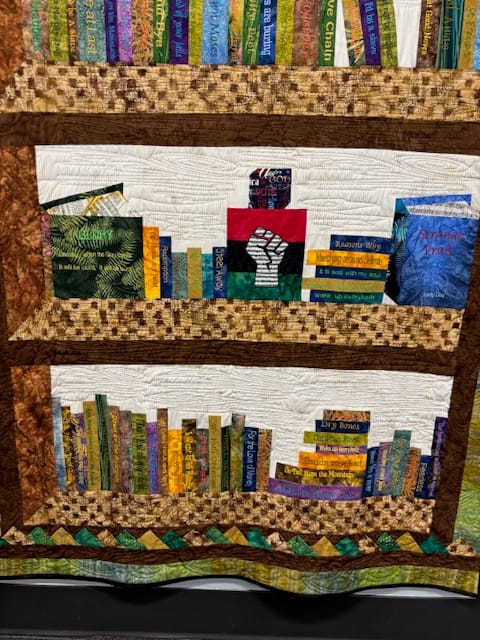
The fiber artist Sharon Tindall often depicts the history of slavery in her vibrant quilts, which show images of “picking cotton” and Union and Confederate flags. In response to the murder of George Floyd, she sewed a quilt with an image of books on a shelf, the spines of which contain phrases such as “slave chain” that she told me kept running through her head at the time. “I wanted to do something, but couldn’t [go anywhere] because it was Covid,” she says, so she responded with her art. “What I want to do is to educate people through quilting,” she told me.
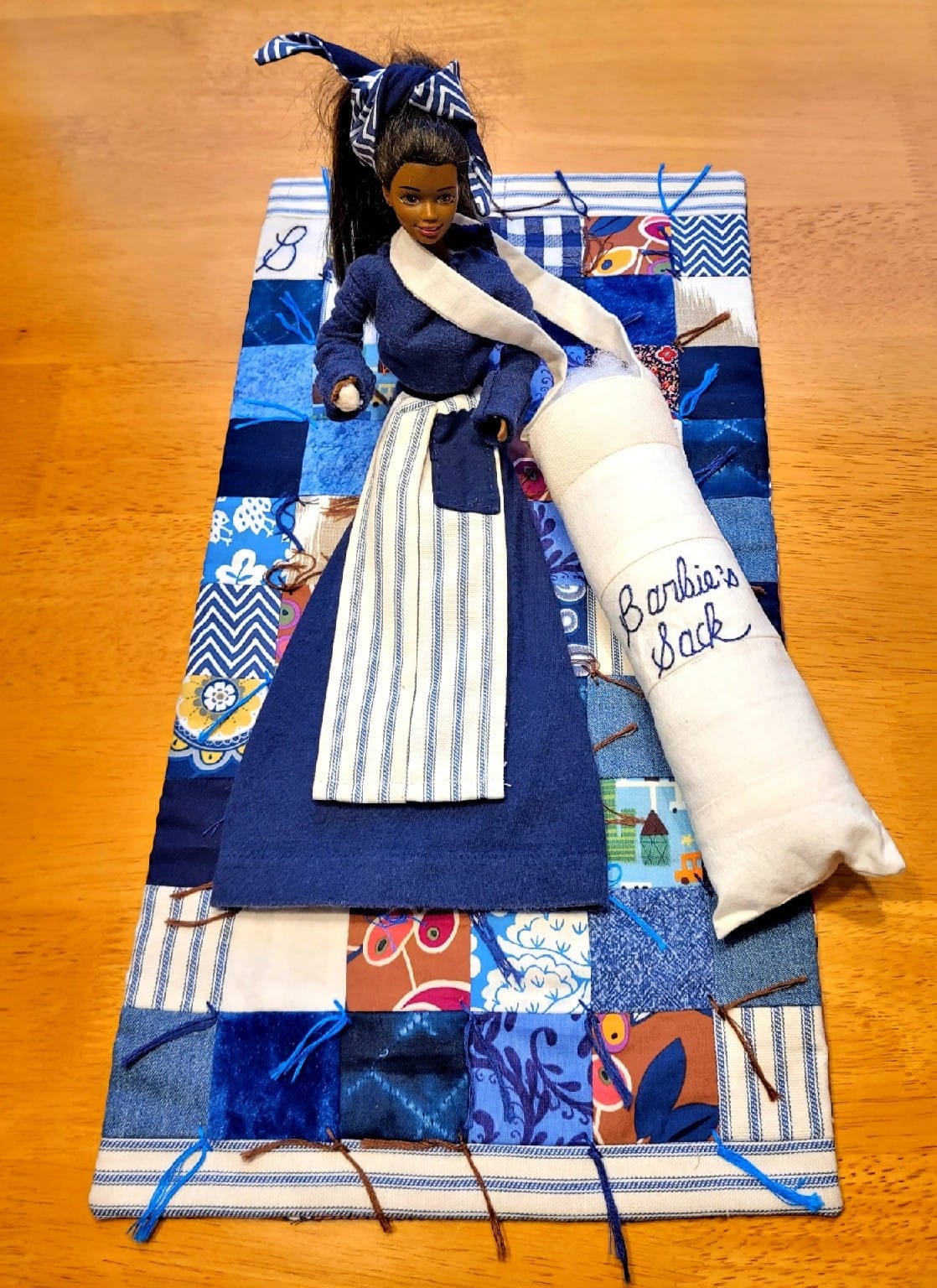
J. Janice Coleman, an artist and English professor at Mississippi’s Alcorn State University, uses her needlework to tell stories, highlighting luminaries in Black history, including the civil rights activist Fannie Lou Hamer and the author Toni Morrison. Inspired by her childhood in Mound Bayou, Miss., an exclusively Black town founded by formerly enslaved people in 1887, she also makes cotton sacks, some adorned with quotes from President Barack Obama, as well as a series of sacks meant to be carried by Barbie dolls. “I thought, if [Barbie] were in the Mississippi Delta, and not in California, then she would be carrying a cotton sack,” she says.
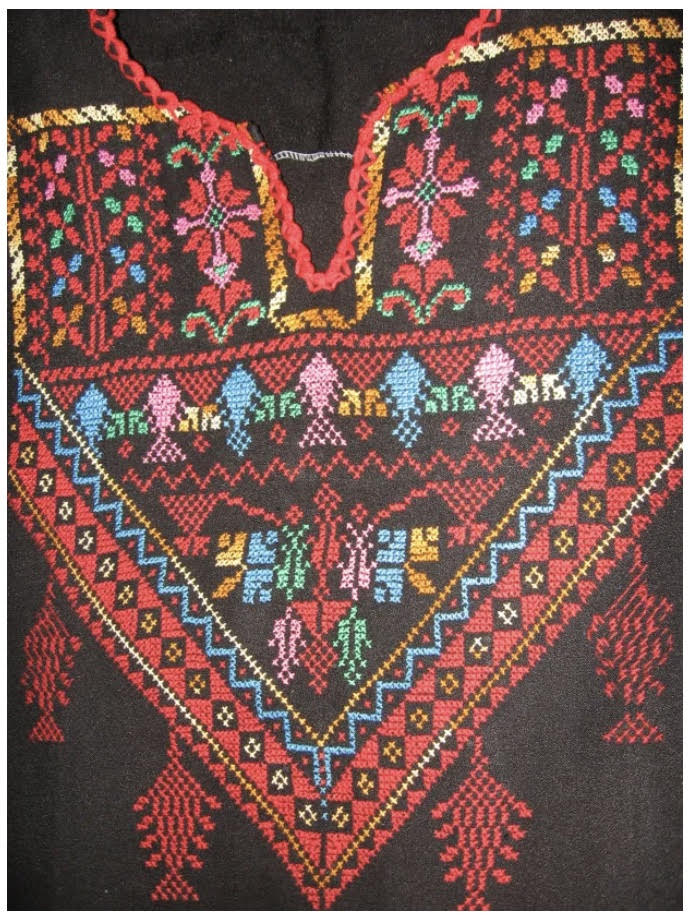
Using craft to convey or subvert narrative is also present in Tatreez, the ancient Palestinian art of cross-stitching. Wafa Ayyad, an 8th grade English Language Arts teacher in New Jersey who also leads workshops in Tatreez, including at the Newark Museum of Art, explains that the craft has a rich history as a symbol of resistance, particularly after 1948 and the advent of the Arab-Israeli war. Palestinian women would stitch upside-down Cypress trees into their traditional Palestinian dresses to connote the destruction wrought by the conflict. The art also features elements from the Palestinian landscape, like orange blossoms and native birds, along with details that reveal the wearer’s home village and class.
“In the 1980s, when Palestinians were banned from displaying the flag, they put Palestinian flags [on their dresses] as a form of resistance,” says Ayyad.
“Whenever there is conflict, you’re going to find craftivism,” says Mashaal, of Needle and Skein. “Knitters and crocheters are … socially minded. They care about their communities and want to help.”
Knitting = networking
Betsy Greer, the author of “Knitting for Good: A Guide to Creating Personal, Social, and Political Change Stitch by Stitch” confirms this. “Events like the [Melt the ICE hat-knitting in New Jersey] can really bring people together,” she says. “And when you bring people together, you create discussion — and you create networks.”
Greer points to the fact that communities that had been forged after the murder of George Floyd were already in place and ready to activate five-and-a-half years later when ICE invaded Minnesota. “That wasn’t necessarily through craft, but it is engagement on a community level and working together to craft can be a vehicle for that,” she says.
As for me, my life-affirming experience at Melt the ICE Night wasn’t actually my first brush with craftivism and the powerful togetherness it can forge. That happened nine years ago, on January 21, 2017, when I woke before dawn, dressed in the dark, then nursed my six-month-old daughter before getting on a bus and travelling four hours to Washington, D.C., to fight for her rights — and for my own.
As the bus came over a hill just blocks from the Capitol, I saw them: tens of thousands of pink knit and crocheted hats, like a sky at sunset. The sight, a deliberate and giant middle finger to the self-described “pussy-grabbing” president, brought tears to my eyes.
And I wasn’t the only one.
In the days after the 2017 Women’s March, the news coverage never failed to mention the knit pussy hat, its pinkness, and its two distinctive pointy ears. Cute, sure, but the hat also carried a serious message, one that would not, indeed could not, be missed: We women will not be ignored.
NOTE: The author's bio has been changed to correct the name of her book to What Happened to Paula: An Unsolved Death and the Danger of American Girlhood.”